10 Places Time Built Better Than Any Architect Could
"Nature is pleased with simplicity, and affects not the pomp of superfluous causes." — Isaac Newton wrote that almost 300 years ago, and he had no idea how right he'd turn out to be.
Because here's the thing about nature: given enough time, it doesn't need an architect. It doesn't need a blueprint. Give it a few million years, some lava, a little wind, and the right minerals, and it'll build something that looks suspiciously like it came with a construction permit.
I've lost count of how many times someone's shown me a photo of a "tiled" stone floor or a "carved" staircase, fully convinced a lost civilization made it — only to find out it's just erosion doing what erosion does when nobody's rushing it. That's exactly what's happening at the 10 places below. No masons, no chisels, no blueprints. Just rock, water, and time, quietly outdoing anything we'd have built on purpose.
| Place | Country | "Looks Like" |
|---|---|---|
| Giant's Causeway | Northern Ireland | A paved road into the sea |
| The Wave | USA | A painted sandstone mural |
| Moeraki Boulders | New Zealand | Giant stone cannonballs |
| Pamukkale | Turkey | A white marble staircase |
| Tessellated Pavement | Australia | A tiled floor |
| Zhangye Danxia | China | A striped, painted mountain |
| Chocolate Hills | Philippines | Rows of giant molehills |
| Fairy Chimneys | Turkey | Carved stone towers |
| Antelope Canyon | USA | A sculpted art gallery |
| Devil's Tower | USA | A giant carved tree stump |
Giant's Causeway — Northern Ireland

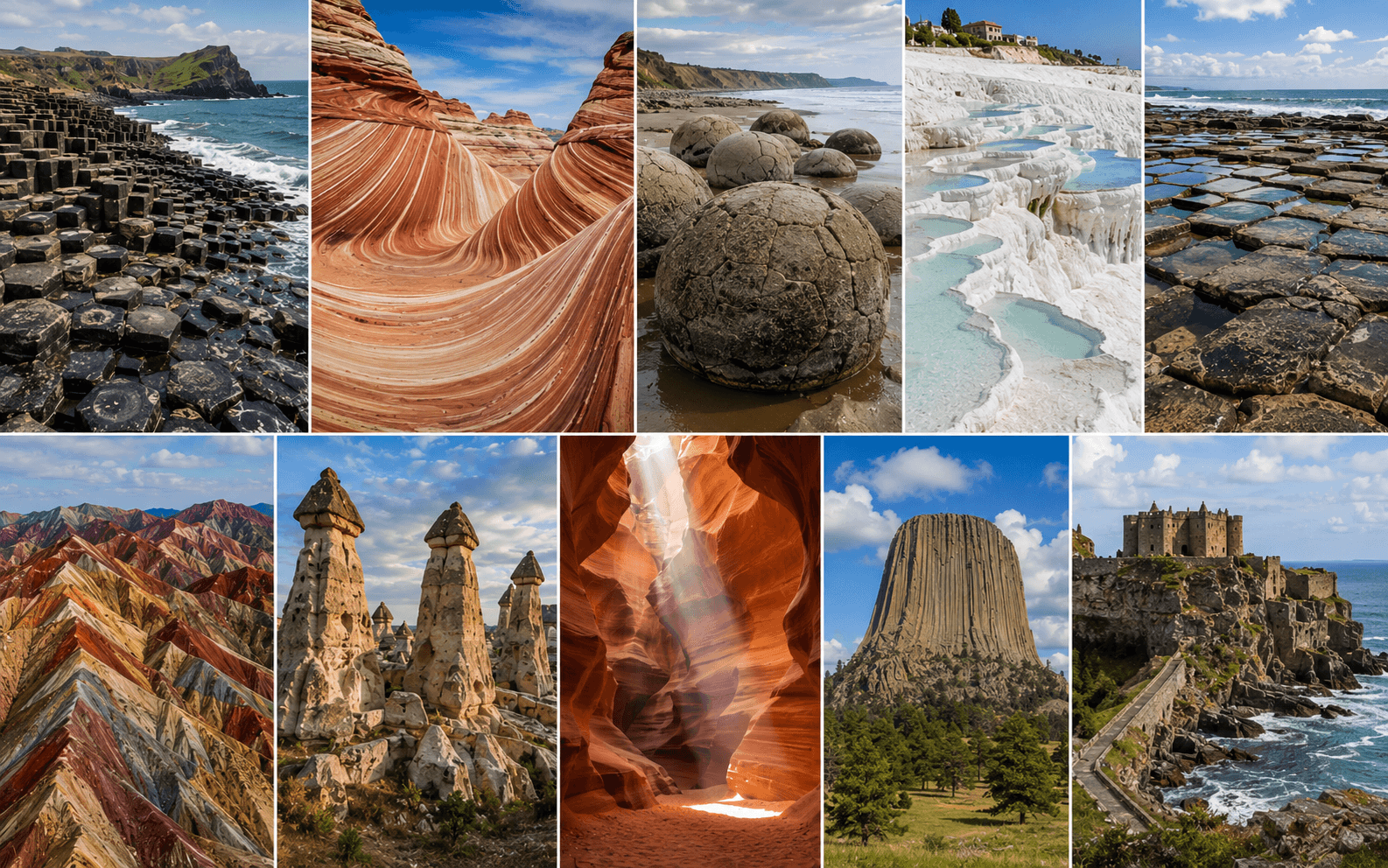
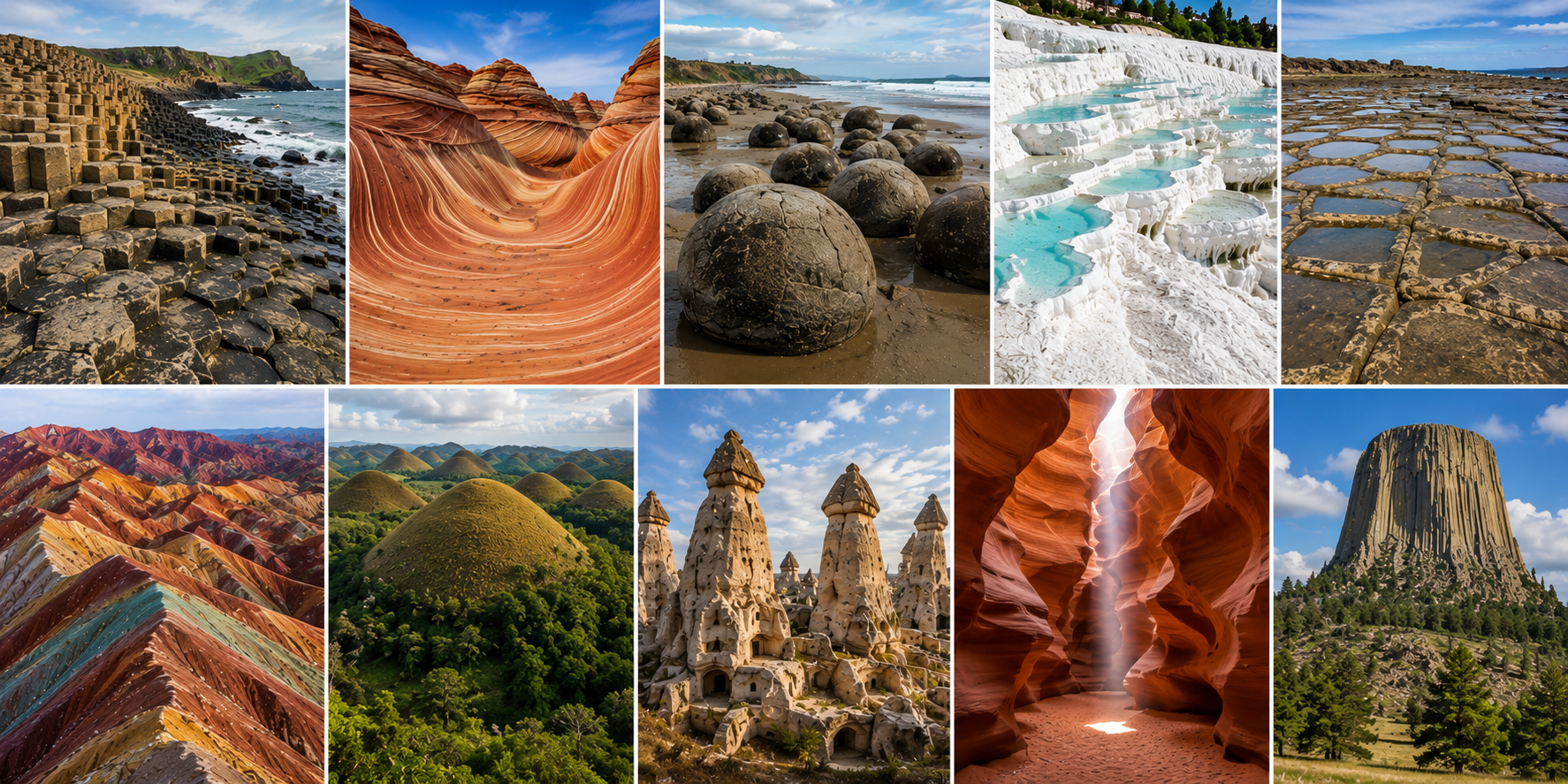
Around 40,000 tightly packed basalt columns, mostly five- or six-sided, form a "road" stepping into the Atlantic. Lava pooled here roughly 50–60 million years ago and cracked into columns as it cooled slowly, some reaching 82 feet tall. Legend blames a giant named Finn McCool; geology blames cooling lava. Now a UNESCO World Heritage Site.
The Wave — Arizona, USA
Swirling red, orange, and cream bands look painted but are mineral stains — iron, manganese, calcium — deposited in Navajo Sandstone that began as desert dunes about 190 million years ago. Water first carved grooves along cracks; wind later polished them into smooth, undulating curves. Only a small number of hikers get a permit each day.
Moeraki Boulders — New Zealand
These near-perfect stone spheres, some up to 7 feet wide, grew like pearls: minerals built up in layers around a tiny organic core (a shell, leaf, or bone) starting about 60 million years ago. The largest took an estimated 4 to 5.5 million years to form, and the ocean is now slowly washing them free of the soft cliffs that held them.
Pamukkale — Turkey

White, stepped pools that look carved from marble are actually travertine, built by 17 hot springs (water up to 100°C) depositing calcium carbonate over hundreds of thousands of years. "Pamukkale" means "cotton castle." The ancient city of Hierapolis sits right above it; both form a joint UNESCO site.
Tessellated Pavement — Tasmania, Australia
This shoreline looks tiled because natural cracks, called joints, split the rock into a neat grid roughly 300 million years ago. Seawater and salt crystals then did the finishing work, wearing some tiles into shallow "pan" bowls and leaving others raised as "loaf" shapes. No mason involved.
Zhangye Danxia — China
Striped, rainbow-colored ridges come from layered sandstone and minerals — iron oxide for red and orange, iron hydroxide for yellow — built up over roughly 24 million years, then tilted upright by tectonic movement. Fact-check: the colors are real, but many viral photos are digitally boosted well past what you'll see in person.
Chocolate Hills — Philippines

Over 1,200 (possibly up to 1,776) nearly identical cone-shaped mounds cover Bohol island. They started as coral reef, were pushed above sea level by tectonic uplift, and were then shaped by rainwater slowly dissolving the limestone — leaving rounded hills 30 to 120 meters tall.
Fairy Chimneys — Cappadocia, Turkey
Nobody carved most of these towers — wind and rain did, wearing away soft volcanic ash-rock (tuff) left by ancient eruptions. Where a harder cap of basalt sat on top, it protected the column beneath, so those pillars grew tall while everything around them wore away. People later carved homes into the soft tuff itself.
Antelope Canyon — Arizona, USA

Smooth, wave-like walls were carved by flash floods, which began cutting into 190-million-year-old Navajo Sandstone around 5 to 6 million years ago. Sand-carrying floodwater acts like sandpaper, and it's still slowly reshaping the canyon. Because floods are dangerous, visits are only allowed on guided Navajo Nation tours.
Devil's Tower — Wyoming, USA
Magma pushed up underground about 40.5 million years ago and hardened into rock without ever reaching the surface as a volcano. As it cooled, it cracked into tall columns; over time, the softer rock around it eroded away, leaving the tower standing 867 feet from base to summit — looking like a giant carved stump.
What Time Builds Alone
So the next time a photo stops your thumb mid-scroll because something looks too neat, too deliberate, too built — take a second look. Nine times out of ten, you're not looking at what's left of someone's ambition. You're looking at what patience does when it's had a few million years and nobody to interrupt it.
Newton was onto something. Nature really doesn't need the extra effort. It just needs time — and apparently, a very good sense of geometry.


