
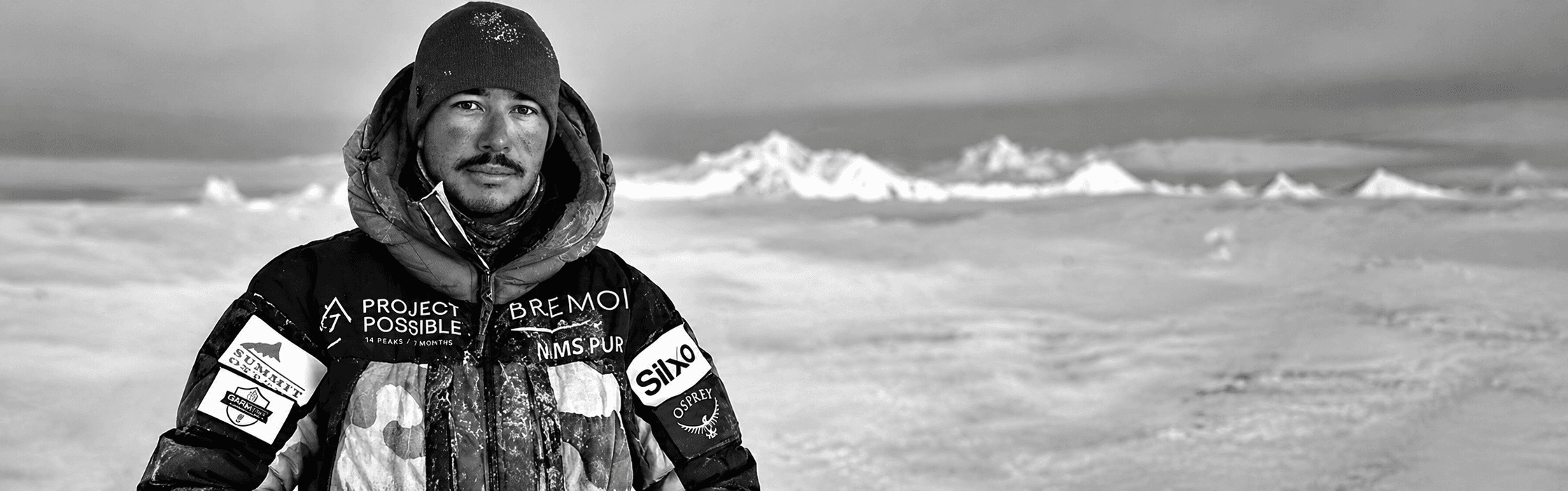
From Gurkha Soldier to Mountaineering Legend: The Life of Nirmal Purja (1983–2026)
"Giving up is not in the blood, sir. It's not in the blood." — Nirmal Purja
Nirmal "Nims" Purja died on July 30, 2026, in an avalanche on Broad Peak, in Pakistan's Karakoram range, along with several other members of his expedition. He was 43. The news landed hard across the mountaineering world — partly because Purja had spent the last decade making the impossible look almost routine, and partly because so few people expected the mountains to be the thing that finally caught up with him.
His story didn't start with climbing at all. It started in a small village in the Himalayan foothills, moved through sixteen years of military service most people will never see the inside of, and only turned toward mountaineering by accident, in his late twenties, on a break from Special Forces duty. What came after changed the sport.
A Childhood in the Shadow of the Himalayas

Purja was born on July 25, 1983, in Dana, a village in Nepal's Myagdi district, beneath the Dhaulagiri range, into a Magar family. Educational opportunities were limited there, so the family eventually relocated to Chitwan so the children could go to school. He later described a childhood spent upstairs from the family's chickens, four days' walk from the nearest road — a detail he returned to often when asked where his tolerance for hardship came from.
Military service ran in the family. His father and three older brothers had all served in Nepal's Gurkha regiments, and by the time Purja came of age, joining the Brigade of Gurkhas wasn't really a choice weighed against alternatives. It was closer to inheritance.
The Making of a Special Forces Soldier (2003–2012)
Purja joined the British Army's Brigade of Gurkhas in 2003, at 18. He has said the decision was never really about money — it came from a pull toward serving in an elite unit, plain and simple. That pull took him further than most: in 2009, he became the first Gurkha ever to pass selection for the UK's Special Boat Service, one of the most demanding special forces units in the world.
He spent close to a decade with the SBS, including deployments to Afghanistan and cold-weather warfare training that had him studying, in clinical detail, how the human body holds up in the harshest conditions on the planet. In 2016, while off-duty near Everest, he took part in a high-altitude rescue of a stranded climber — an act later cited directly in the honor he'd receive years afterward.
The Leap Into Mountaineering

Unlike most elite mountaineers, Purja didn't grow up dreaming of Everest. The idea arrived sideways, during a military break spent at Everest Base Camp — and from being asked, again and again, whether a Nepali man had actually seen the mountain his country was famous for. In 2012, with no prior climbing experience, he made his first major Himalayan ascent: Lobuche East. Later that same year, he summited Everest itself.
Leaving the military for climbing full-time wasn't a clean decision. He was, by then, an important financial contributor to his family — and walking away meant giving up an army pension he'd later call life-changing money.
He took the leap anyway. When sponsors declined to back what would become his signature project, he remortgaged his own home in the UK to fund it.
In 2019-Project Possible: 14 Peaks, 189 Days
In 2019, Purja set out to climb all 14 of the world's 8,000-metre peaks — a feat the previous record-holder, Polish climber Jerzy Kukuczka, had taken nearly eight years to complete — in a single season. He called it Project Possible. Climbing alongside a rotating team that included Mingma Gyabu "David" Sherpa, Lakpa Dendi, Geljen Sherpa, and Tensi Kasang, he summited the first peak on April 23, 2019, and the fourteenth — Shishapangma — on October 29. Total time: 189 days, or six months and six days, smashing the previous record several times over.
Along the way, he photographed the now-famous image of hundreds of climbers queued near Everest's summit — a picture that became shorthand for the sport's overcrowding problem, even as he was busy setting its fastest-ever record. The achievement, and the two years of preparation and financial risk behind it, later became the subject of the 2021 Netflix documentary 14 Peaks: Nothing Is Impossible, longlisted for a BAFTA in 2022, which introduced Purja's name to an audience far beyond climbing circles.
Records, Recognition, and a Career That Never Slowed (2019–2026)
Project Possible was the headline, but it was far from the last entry on Purja's record sheet. He went on to log the fastest ascent of Pakistan's five 8,000m peaks, the fastest climb of all eight of Nepal's 8,000ers, and the fastest link-up of Everest, Lhotse, and Makalu summits — 48 hours and 30 minutes apart. In January 2021, he was part of the ten-person Nepali team that completed the first-ever winter ascent of K2, closing out the last 8,000m peak that had never been climbed in winter.
2018 — Appointed MBE by Queen Elizabeth II, for outstanding achievement in extreme high-altitude mountaineering2020 — Named "Sherpa of the Year"; receives the Piolet d'Or Asia award2021 — First winter ascent of K2, with a Nepali climbing team2023 — Honorary doctorate, Loughborough University; granted Non-Resident Nepali citizenship2026 — Continues climbing into his final season, including a summit of Gasherbrum I in July
Elevating Nepal's Climbers
Purja's climbing career doubled as a long-running argument: that Nepali climbers, so often cast as support staff for foreign expeditions, belonged in the story as equals. He co-founded Elite Exped alongside fellow Nepali climbers Mingma David Sherpa and Tejan Gurung — his own brother-in-law — building it into one of the most prominent Nepali-owned expedition operators on the 8,000m circuit, with an emphasis on safety and Nepali leadership rather than the traditional guide-for-hire model. His charitable foundation supported young climbing talent regardless of background, and in 2023 he postponed his own summit attempt on Shishapangma after an avalanche killed two members of another team — a decision that drew as much attention as any of his records.
JULY 30, 2026: The Final Expedition

Purja was leading a multinational team on Broad Peak — Nepali climbers alongside mountaineers from the United States, Oman, China, and Pakistan — when an avalanche struck. Elite Exped confirmed his death in a statement days later, along with the deaths of several other members of the expedition. He was 43, and by most accounts still actively climbing at the highest level right up to his final weeks.
What He Leaves Behind
Strip away the record book and what's left is a fairly simple throughline: a soldier's discipline, applied without much modification to a sport that had mostly been defined by Western climbers and the Nepali guides who got them to the top. Purja spent his career trying to flip that arrangement — climbing at a pace nobody thought was survivable, then using the attention it bought him to argue that the people who'd always done this work deserved equal billing.
He didn't grow up dreaming of Everest. He ended up redefining what climbing all of it, and then some, could even mean.
“One of the world's greatest mountaineers, putting Nepalese climbers on the map.” — Prince William, in a statement following Purja's death


