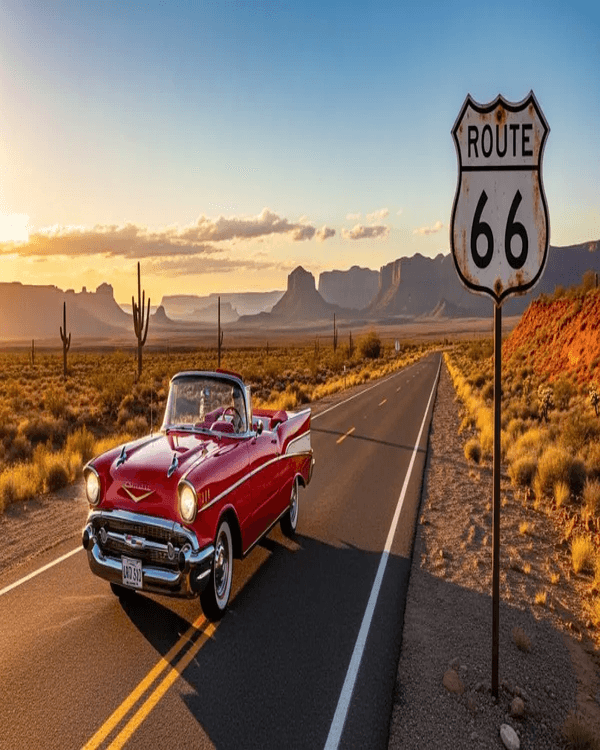
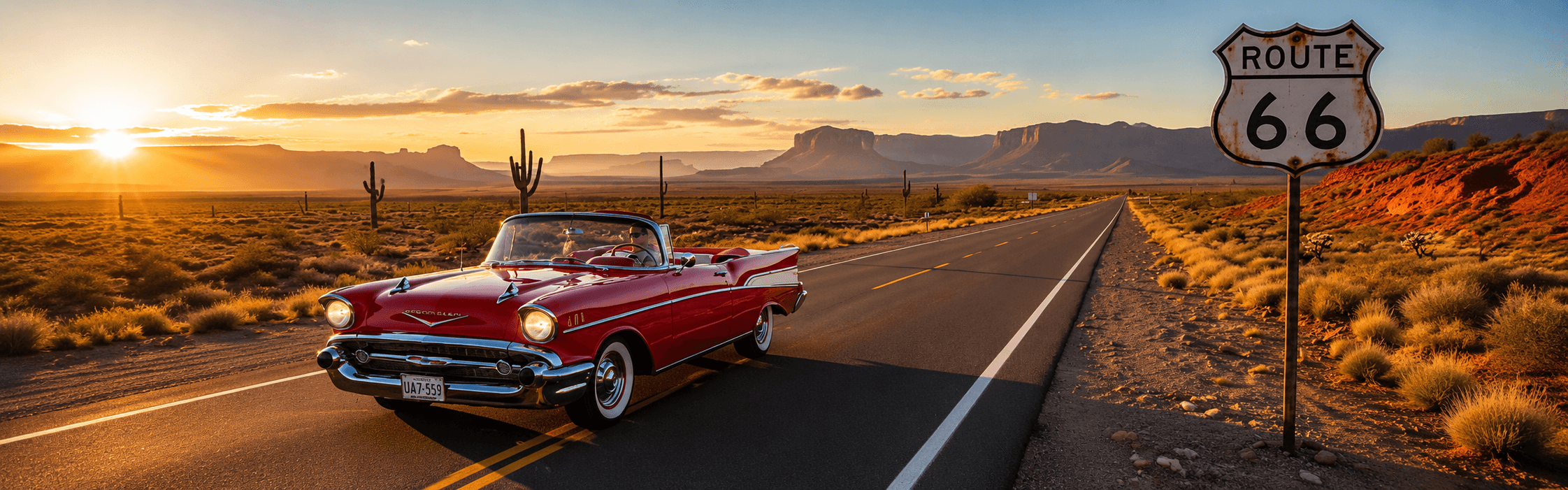
How Route 66 Became the World's Most Famous Road Trip
In November 2026, Route 66 turns 100. A road doesn't usually get a birthday — bridges, buildings, borders, sure, but not a strip of asphalt connecting two-lane towns across eight states. Route 66 gets one anyway, because at some point in the last century it stopped being a highway and became something closer to a myth.
The road itself was never even the longest or the fastest way across the country. It was decommissioned in 1985, replaced piece by piece by faster interstates, and by most practical measures it should have disappeared the way old roads usually do. Instead, a century after a telegram assigned it the number 66, people still fly in from other countries just to drive it.
This is the story of how that happened — the freedom it sold, the roadside culture it built, the near-death it survived, and why 2026 is turning out to be the biggest year in its history.
| Established | Original length | States crossed | Decommissioned | Still drivable today |
|---|---|---|---|---|
| November 11, 1926 | 2,448 miles (~3,940 km) | 8 — Illinois to California | June 27, 1985 | ~85% of the original route |
How a 1926 Numbering Decision Became an American Myth

Route 66 wasn't built from scratch. It was assembled — a patchwork of existing roads stitched together and given a single number as part of the country's first federal highway system. A telegram proposed the number 66 on April 30, 1926; the designation was approved that November 11, linking Chicago to Santa Monica across 2,448 miles and eight states. Only about a third of it was paved at first. The rest was dirt, gravel, or in places, wooden planks.
The branding did more work than the pavement did. Oklahoma highway commissioner Cyrus Avery pushed the road as the "Main Street of America" — not just the fastest way west, but the friendliest one, running straight through the center of small towns rather than around them. That decision, to route the highway through Main Street instead of bypassing it, is the entire reason roadside culture along Route 66 exists at all.
What Made Driving Route 66 Feel Like Freedom

The road's meaning shifted almost immediately. During the Dust Bowl years of the 1930s, Route 66 carried thousands of migrant families west out of Oklahoma, Texas, and Kansas toward California, fleeing failed farms for the promise of work. John Steinbeck gave that migration its permanent nickname in 1939, calling it the "Mother Road" in a novel that turned the highway into literary shorthand for escape as much as travel.
After World War II, the same highway took on the opposite emotional register entirely. Gas was cheap, cars were suddenly aspirational rather than just functional, and a stretch of road built for desperate migration became the backdrop for a completely different kind of American story — the family road trip, undertaken for the sheer pleasure of it. A hit song in 1946 turned the highway's name into shorthand for that feeling, and for decades afterward, "Route 66" meant something closer to an idea than an actual set of coordinates: open road, no fixed schedule, adventure as the entire point of the drive.
The Roadside Culture That Turned a Highway Into a Pilgrimage

The art and oddities
Some of the road's most famous stops exist purely because someone decided a highway needed more personality than asphalt could provide on its own. Cadillac Ranch, just outside Amarillo, Texas, is ten Cadillacs buried nose-down in a field at an angle borrowed from the Great Pyramid of Giza — a 1974 art installation that visitors are actively encouraged to spray-paint, so the piece is different every time someone stops.
The Blue Whale of Catoosa started even smaller: an Oklahoma man named Hugh Davis built an 80-foot smiling blue whale beside a swimming pond in the early 1970s as an anniversary gift for his wife. It was never meant to be a tourist attraction. It became one anyway, the way most of the road's best stops did — as a side effect of someone's personal, slightly excessive gesture.
The motels that never stopped glowing
The Wigwam Motel in Holbrook, Arizona, rents out concrete teepee-shaped rooms that have been drawing overnight guests since the 1950s, each with its own vintage car parked out front for the photo. The Blue Swallow Motel in Tucumcari, New Mexico, has operated continuously since 1939, its neon sign still one of the most photographed on the entire route. Neither motel updated its aesthetic to compete with anything modern — the appeal was always that they didn't.
The scenic stretches
Between the roadside attractions, the road runs through landscape that needs no embellishment at all: the layered red and orange badlands of the Painted Desert in Arizona, the flat, wide-open sky of the Texas Panhandle where the horizon barely seems to bend, and the sun-bleached emptiness of the Mojave Desert stretching toward California. If the kind of open-road freedom that pulls travelers toward Route 66 sounds familiar, our guide to solo travel destinations covers a close parallel — Iceland's self-drive Ring Road — on a completely different continent.
How the Interstate System Nearly Killed It

Route 66's decline started with an idea President Eisenhower brought home from Europe. He'd seen Germany's Autobahn during the war and wanted an American equivalent — controlled-access highways built for speed rather than scenery. He signed the Federal-Aid Highway Act in 1956, and the new interstate system began quietly replacing Route 66 piece by piece: I-55 from Chicago to St. Louis, I-44 through Oklahoma, I-40 across the Texas Panhandle and Arizona, I-15 and I-10 for the final stretch into California.
The new roads were faster and safer, but they were also built to bypass the small towns Route 66 had been designed to run straight through — which meant every diner, motel, and gas station that depended on passing traffic lost its reason to exist almost overnight. The last original stretch, in Williams, Arizona, was bypassed by I-40 in October 1984. On June 27, 1985, the American Association of State Highway and Transportation Officials formally decertified Route 66, voting to remove its highway signs entirely. Fifty-nine years after that 1926 telegram, the road stopped officially existing.
Why Route 66 Refused to Disappear
Decommissioning turned out to be a legal technicality more than an actual ending. Roughly 85 percent of the original road remained physically intact, and the businesses that had survived the interstate's arrival organized instead of closing. Route 66 as a whole was never designated a National Scenic Byway — the road doesn't carry that status — but preservation groups across all eight states protected the surviving alignments through Historic Route 66 designations, state preservation programs, museums, and heritage tourism initiatives instead.
What emerged wasn't a working highway anymore — nobody uses Route 66 to actually get anywhere efficiently. What emerged was something closer to a pilgrimage route, driven specifically because it's slow, not despite it. For readers drawn to that same instinct — choosing the longer, slower way on purpose — our piece on why slow travel is having a moment covers the broader trend Route 66 arguably invented decades early.
Is Route 66 Still Worth Driving in Its 100th Year?
Yes — 2026 marks Route 66's 100th anniversary, with a federally authorized Centennial Commission coordinating a year-long program of festivals, classic car rallies, and preservation events across all eight states, making this the single biggest year in the road's history to actually drive it.
The centennial isn't concentrated on one date. Celebrations run from the official kickoff on April 30, 2026 — a hundred years to the day after the number 66 was first proposed — through November 11, the road's actual 100th birthday, with individual towns weaving their own festivals into the year-long program. That spread means there's no single "right" week to visit, but it also means accommodation along popular stretches is booking out further in advance than in any previous year, so travelers planning a centennial trip should lock in lodging early rather than assuming a classic motor court will have a free room.
Driving the entire 2,448 miles isn't required to get the experience — plenty of travelers pick a single state or a specific stretch and let the centennial atmosphere do the rest. For the practical side of planning an international trip like this, our visa guide for Indian travellers and travel budget framework both cover groundwork worth sorting before booking flights.
Frequently Asked Questions
Is Route 66 still drivable today?
Yes — an estimated 85 percent of the original road remains intact and drivable, though not as a single continuous highway. Most travelers alternate between preserved historic alignments and short stretches of interstate to connect them, particularly through Oklahoma and Arizona, where the historic route is best preserved.
How long does it take to drive the whole route?
A full end-to-end drive from Chicago to Santa Monica typically takes 10 to 14 days at a comfortable pace, allowing time to stop at roadside attractions rather than just passing through. It's drivable faster, but that defeats most of the point.
What's the best time of year to drive Route 66?
Spring and fall generally offer the most comfortable driving conditions, avoiding both the Mojave Desert's summer heat and winter weather risk in the higher-elevation stretches through Arizona and New Mexico. During the 2026 centennial specifically, April through June and the weeks around November 11 will see the heaviest event activity.
The Takeaway
A hundred years is a strange amount of time for a road to survive being replaced. Route 66 didn't win by staying necessary — it lost that fight to the interstate system decades ago. It won by becoming the kind of place people choose on purpose, slower and less efficient than the alternative, for reasons that have nothing to do with actually getting anywhere.
That's the whole trick of the thing, really. A road that stopped being the fastest way west somewhere around 1970 is, in its hundredth year, more popular than it's ever been — proof that freedom and nostalgia, it turns out, age better than efficiency ever does.


