Why Do People Keep Falling in Love With Paris?
Paris welcomed 48.7 million visitors in 2024, and by most tourism board math, that number should keep climbing the way visitor numbers usually do for any well-marketed capital. But raw numbers don't explain why people describe falling in love with Paris the way they'd describe falling in love with a person — repeatedly, irrationally, even after knowing better.
Other cities have taller skylines, bigger museums, newer attractions. What Paris has that almost nowhere else does is a head start: most people fall for Paris before they ever board a flight, through novels and films and photographs that turn the city into something closer to a shared memory than a destination. By the time they land, they're not discovering Paris. They're checking whether it matches what they already believed.
| 2024 visitors to Greater Paris | International tourism revenue (2024) | World ranking | Most visited paid monument |
|---|---|---|---|
| 48.7 million | €71 billion | 5 consecutive years atop Euromonitor's Top 100 City Destinations Index | Eiffel Tower — ~6 million visitors/year |
Why Paris Feels Familiar Before You've Ever Been

Paris has spent two centuries accumulating storytellers. Victor Hugo turned its streets into the backdrop for two of the most enduring novels in French literature, giving Notre-Dame and the city's underworld a permanence that outlasted the buildings themselves. Decades later, Ernest Hemingway wrote about his years in the city with the kind of affection that turned an entire era — cheap cafés, broke writers, long walks along the Seine — into a genre of its own, one that still shapes how people picture 1920s Paris even if they've never read a word of it directly.
Film picked up where literature left off. Amélie found wonder in unglamorous corners of Montmartre. Midnight in Paris built an entire plot around the fantasy of stepping backward into someone else's golden age of the city. More recently, a Netflix series turned Paris into aspirational content for a generation that discovers cities through a feed rather than a paperback. None of these versions replace each other — they stack, so that arriving in Paris for the first time can feel less like visiting somewhere new and more like walking into a set built from decades of other people's stories.
What makes this different from most cities' cultural exports is the sheer density of it. A traveler can spend a week in Paris without ever consciously referencing a film or novel and still find themselves recognizing corners, light, and street angles they've somehow seen before — the accumulated effect of decades of media rather than any single deliberate reference point.
The City That Was Designed to Be Remembered

Part of why Paris still resembles its own mythology is that very little of it was left to chance. In the mid-1800s, Baron Georges-Eugène Haussmann tore through the city's medieval street layout and rebuilt it around wide boulevards, uniform limestone façades, and consistent building heights — a redesign so thorough that most of central Paris still follows his blueprint more than 150 years later.
Most global capitals have since layered glass towers over their historic cores. Central Paris mostly hasn't, held in place by heritage protections strict enough that a new building's height and materials are dictated as much by 19th-century precedent as by 21st-century architecture. The result is a city where the streets that inspired painters and novelists a century ago still look close enough to recognizable — not preserved as a museum piece, but genuinely still in use, with laundry hanging from balconies and delivery scooters weaving down the same boulevards Haussmann laid out for horse-drawn carriages.
Why Paris Sells Atmosphere, Not Attractions

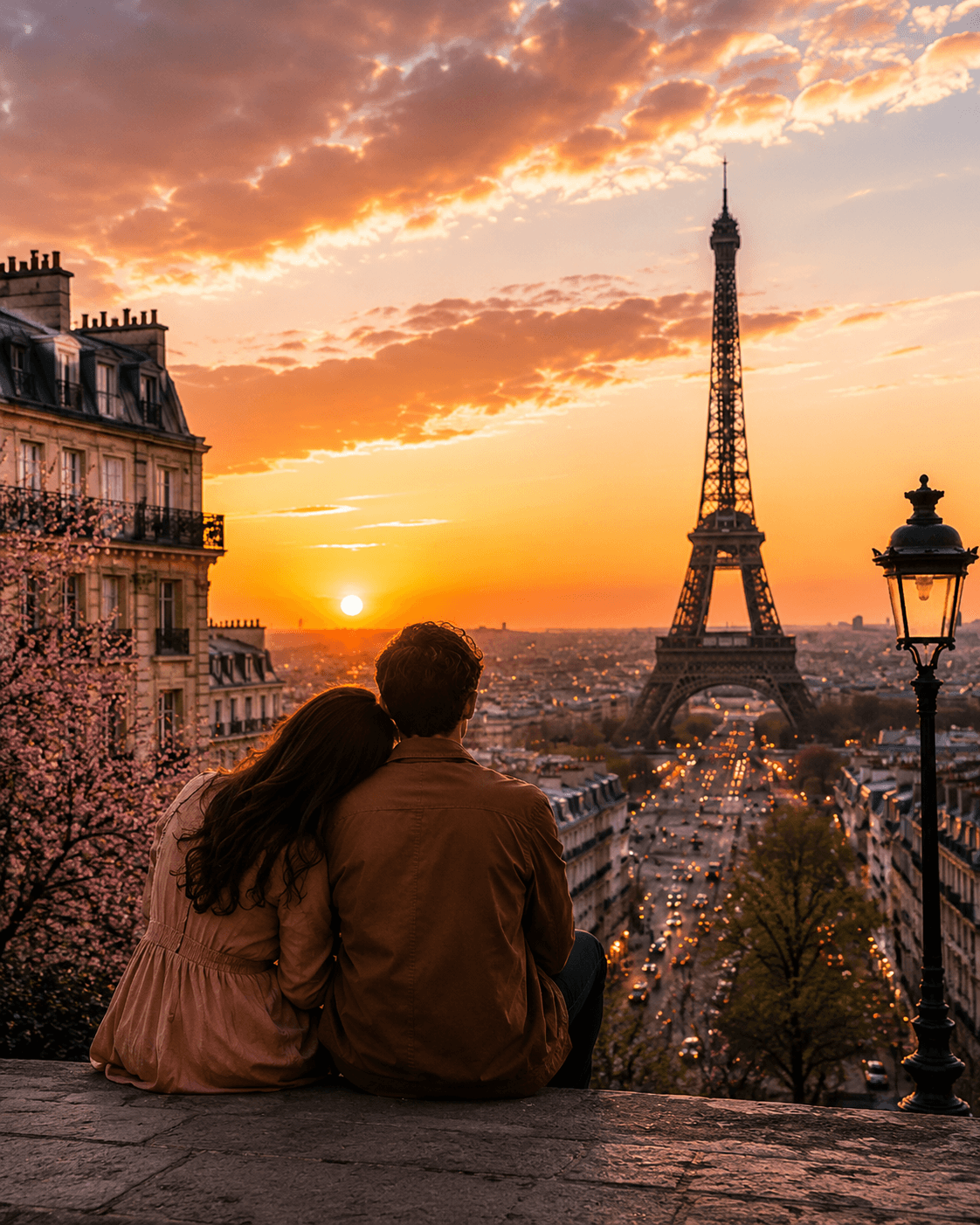
Ask someone what they remember from a trip to Paris, and the Eiffel Tower rarely tops the list — even though it's the reason most people booked the flight in the first place. What tends to stick instead is smaller and harder to plan for: the smell of a boulangerie at 7am, a violinist playing under a stone bridge, the particular gold light the Seine takes on right before sunset.
That's not an accident of memory so much as how atmosphere works on the senses in ways a checklist of monuments doesn't. A single café morning with nowhere to be does more for how a trip gets remembered than an efficiently ticked-off itinerary of landmarks, which is part of why so many travelers arrive with a list and leave having barely followed it.
Why Artists Never Stopped Coming Here

For well over a century, Paris has functioned less like a backdrop for creative people and more like an actual ingredient in their work. Claude Monet spent years painting the shifting light over the same water lilies. Pablo Picasso and a generation of modernists reinvented what painting could look like inside cramped Montmartre studios. James Baldwin left the United States for Paris in the late 1940s and found, among other things, a place where he could write without the specific weight of American racism pressing on every page. Simone de Beauvoir and Jean-Paul Sartre turned Left Bank cafés into informal philosophy seminars that ran for hours over the same cup of coffee.
None of that happened because Paris was simply pretty. It happened because the city was walkable, the cafés were cheap enough to sit in for an afternoon, and there was a critical mass of other people doing the same thing — conditions that made creative work feel less like an isolated act and more like a shared, ongoing conversation. Walking those same streets today means walking through the actual physical setting where a lot of that work was first sketched out, not just a themed recreation of it.
What Is Paris Syndrome, and What Does It Actually Prove?
Paris Syndrome is a real, if rare, psychological condition — first identified by Japanese psychiatrist Hiroaki Ota in 1986 — in which the gap between a traveler's idealized image of Paris and the city's actual, imperfect reality triggers acute distress, including anxiety, disorientation, and occasionally hallucinations.
The condition isn't officially listed in psychiatric diagnostic manuals, but it's been documented by doctors at Paris hospitals for decades, and it's reported most often among Japanese visitors, whose cultural image of Paris tends to be especially idealized. Reuters reported in 2007 that roughly a dozen Japanese tourists a year sought psychological treatment after the city's crowded streets, unfriendly encounters, or general grit collided with expectations built entirely on film and advertising. In extreme cases, embassies have arranged early flights home for visitors convinced their hotel rooms were being watched.
It sounds like the opposite of a love story, and in the most literal sense, it is — a diagnosis built entirely on disappointment. But it's also proof of how strong the imagined version of Paris actually is, strong enough to cause a measurable physical reaction when reality doesn't match it. The travelers who fall hardest for the real city tend to be the ones who let that initial gap settle rather than fight it — the postcard image fades within a day or two, and what's left underneath, imperfect and genuinely lived-in, turns out to be more durable than the fantasy ever was.
Frequently Asked Questions
How many people visit Paris every year?
Greater Paris welcomed 48.7 million visitors in 2024, generating €71 billion in international tourism revenue, and the city has topped Euromonitor's Top 100 City Destinations Index for five consecutive years.
Is Paris Syndrome a real medical condition?
It's a real, documented phenomenon, though it isn't listed in official psychiatric diagnostic manuals like the DSM. Doctors in Paris have treated cases since the 1980s, and it's most frequently reported among Japanese tourists.
What's the best way to experience Paris beyond the major landmarks?
Building in unstructured time works better than a packed itinerary — a slow café morning, an aimless walk through a neighborhood with no destination, or sitting by the Seine at sunset tend to be what travelers remember longest, more than any single monument.
The Takeaway
Paris is not, by most objective measures, a perfect city. Crowded platforms, rainy mornings, tourists photographing crowds photographing them back — none of that fits the mythology built up over two centuries of novels and film. And yet the gap between that mythology and the real, occasionally difficult city underneath it isn't what breaks the spell for most visitors. It's what completes it.
People don't keep falling for Paris because the postcard version turns out to be true. They fall for it because eventually the postcard fades, and what's underneath is a city that's still, after everything, worth walking slowly through — imperfect, crowded, occasionally frustrating, and somehow none of that cancels out the pull.


