Flight Delay Rights: What Changes in the US on 19 October 2026?
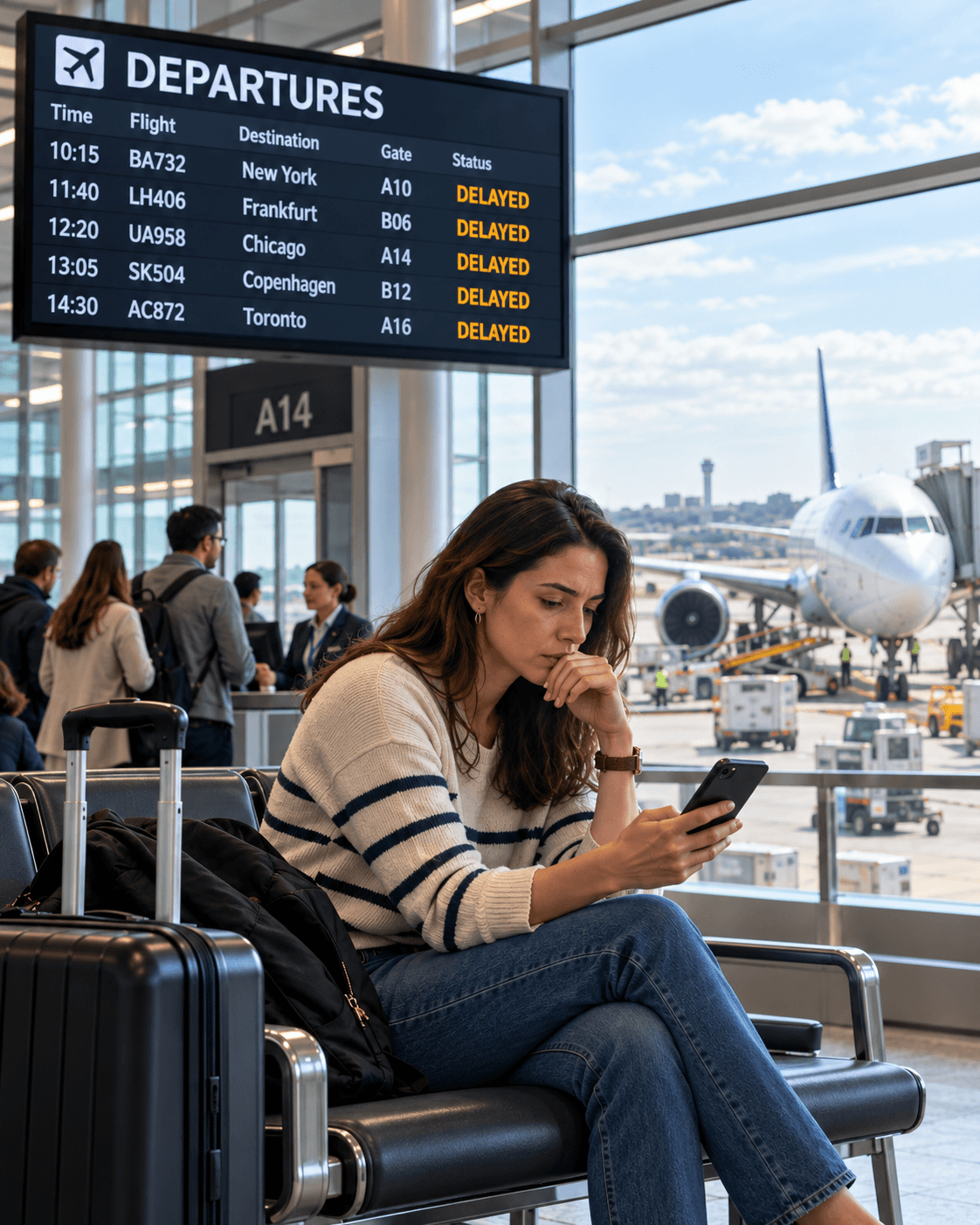
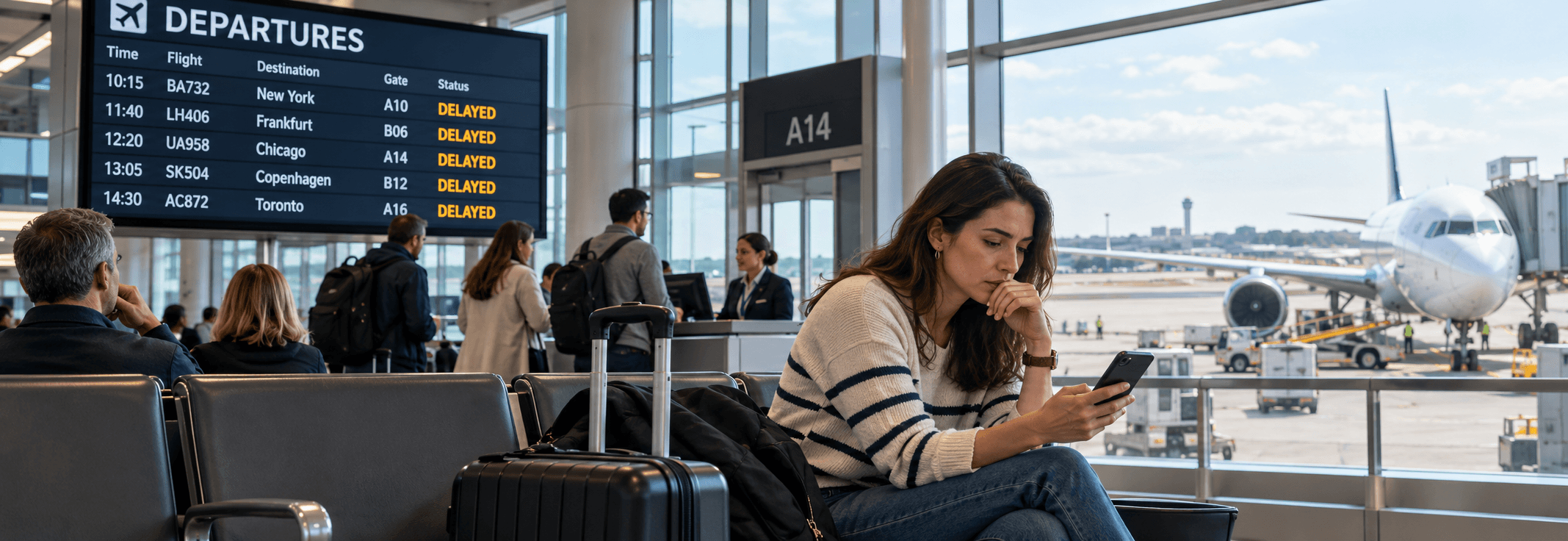
The board flips from “On time” to “Delayed”. Then a new departure time. Then “See agent”. A queue forms at the gate, and everyone in it is asking the same thing: what does the airline owe me now?
In the United States, part of that answer changes on 19 October 2026. A new Department of Transportation rule moves ten kinds of disruption outside the airline’s control, and that is the label that decides whether you get a meal voucher or a hotel room.
Flying in Europe or the UK works differently. There, a long delay can mean cash compensation of up to €600 or £520. Here is what changes, what stays the same, and which rules cover your flight.
- From 19 October 2026, ten US disruption causes, including unscheduled maintenance, medical emergencies and cyberattacks, no longer count as within the airline’s control.
- For those delays, US airlines no longer have to honour their published promises of meals and hotels.
- Your US refund rights do not change. If your flight is cancelled or significantly changed and you choose not to fly, you get your money back.
- In the EU and the UK, arriving more than three hours late can earn €250–€600 or £220–£520, unless the cause was extraordinary.
- Europe’s reformed rules start on 23 October 2027. Until then, today’s EU rules apply.
1. What changes on 19 October 2026?
US law does not require airlines to pay cash compensation for delays. What travellers get instead comes from each airline’s own customer service commitments: meal vouchers, hotel rooms, rebooking. Airlines publish these on the Department of Transportation’s customer service dashboard at FlightRights.gov, and once made they are enforceable.
Those promises only apply when the delay or cancellation is the airline’s fault, which the industry calls a “controllable” disruption. The new rule, published in the Federal Register on 3 September 2026 under the FAA Reauthorization Act of 2024, takes ten causes out of that category from 19 October 2026 (Flight News Daily).
The Department of Transportation expects fewer disruptions to come with meals, hotels or compensation as a result (The Points Guy). Airlines can still choose to look after you. They just no longer have to for these causes.
2. The ten disruptions covered by the new US rule
From 19 October, these count as outside the airline’s control (AeroCorner):
- Cleaning the aircraft after a passenger dies on board
- Aircraft damage from extreme weather, debris on the runway or sabotage
- Baggage or cargo loading delays from a bag system outage the airline doesn’t run
- Cyberattacks, if the airline followed the cybersecurity rules
- Unexpected failure of a government system needed to fly safely
- Overheated brakes after a safety incident
- Unscheduled maintenance that can’t be deferred
- A medical emergency the airline didn’t cause
- Removing an unruly passenger
- Airport closures from volcanic ash, high winds or wind shear
The biggest change for most travellers is number seven. Mechanical problems used to be the classic “airline’s fault” delay. Routine, planned maintenance still counts as controllable, but a fault found before departure that must be fixed now does not.

3. US flight delay rights: refunds, meals and hotels
Refunds stay exactly as they were. Under the Department of Transportation’s 2024 rule, you are owed an automatic cash refund if your flight is cancelled or significantly changed and you decide not to travel (US DOT).
- A significant change means departing or arriving more than 3 hours off schedule on a domestic flight, or more than 6 hours on an international one.
- The refund goes back to your original payment method: within 7 business days for card payments and 20 calendar days for other methods.
- A voucher or travel credit is only allowed if you choose it.
Meals and hotels depend on two things: what your airline promises on FlightRights.gov, and whether the cause counts as controllable. Weather and air traffic control were already outside the airline’s control. From 19 October, the ten causes above join them.
If you accept a rebooking and fly, you are not owed a refund. Ask before you accept.
4. Flight delay rights compared: US, EU and UK
| United States | European Union | United Kingdom | |
|---|---|---|---|
| Cash compensation for delays | None required by law | €250–€600 for arriving 3+ hours late | £220–£520 for arriving 3+ hours late |
| Meals and hotels | Airline’s own promises, controllable delays only | Required from 2–4 hours, depending on distance, whatever the cause | Required from 2–4 hours, depending on distance, whatever the cause |
| Refund if you don’t travel | Cancellation, or 3+ hours (domestic) / 6+ hours (international) | Delay of 5+ hours | Delay of 5+ hours |
| Main exception | Uncontrollable causes, now including the ten above | Extraordinary circumstances (compensation only) | Extraordinary circumstances (compensation only) |
Sources: US DOT, the EU’s Your Europe passenger rights page and the UK Civil Aviation Authority.
5. Which rules apply to your flight?
It depends on where the flight leaves from and which airline operates it, not on your nationality.
- EU rules cover every flight departing an EU airport, whatever the airline, and flights into the EU on an EU airline. They also apply in Iceland, Norway and Switzerland.
- UK rules cover every flight departing a UK airport, and flights into the UK on a UK or EU airline.
- US refund rules cover flights to, from and within the United States.
So Paris to New York on a US airline is covered by EU rules, but New York to Paris on the same airline is not, because the airline is not European. London to New York is covered by UK rules on any airline. A return trip can fall under different rules in each direction.
Crossing Europe soon? Our guide to what the ETIAS delay means for your trip covers the new border checks.
6. EU and UK compensation: when can you claim?
You can claim if you reach your final destination more than three hours late, and the cause was not an extraordinary circumstance. The amount depends on distance, not on what you paid:
- Up to 1,500 km: €250 in the EU, £220 in the UK.
- 1,500 to 3,500 km, and longer flights within the EU: €400, or £350.
- Over 3,500 km: €600, or £520, for arriving more than 4 hours late. Between 3 and 4 hours late, it is €300, or £260.
Extraordinary circumstances include bad weather, air traffic control decisions and security risks. Most technical faults and strikes by the airline’s own staff do not count, so the airline still pays (Your Europe). Even when no compensation is due, the airline must still provide meals and, if needed, a hotel.
Europe’s reform, Regulation (EU) 2026/2202, keeps these amounts and the three-hour trigger. From 23 October 2027 it adds a nine-month deadline for claims, a 30-day deadline for airlines to answer, and a three-night limit on hotels when the cause is extraordinary (Burges Salmon).

7. What to do if your flight is delayed or cancelled
- Get the reason in writing. Screenshot the app notification or ask the gate agent. In the US, the cause now decides whether meals and hotels are owed.
- Don’t accept a rebooking too quickly if you might rather cancel. Flying on the new booking ends your right to a refund.
- Ask for vouchers before you buy anything. If none are offered, keep every receipt and stick to reasonable costs.
- Note your actual arrival time. EU and UK compensation is based on when the aircraft door opens at your destination.
- Check your travel insurance or card cover. Trip delay cover often pays for meals and hotels the airline no longer has to. Our travel insurance guide explains what to look for.

8. How to claim refunds, expenses and compensation
Refunds (US): they should arrive automatically once you decline to travel. If one doesn’t, request it through the airline and, if refused, file a complaint with the US Department of Transportation.
Expenses: send receipts to the airline’s customer relations team with your booking reference and the delay reason you recorded.
EU and UK compensation: claim directly from the airline that operated the flight. It is free. If the airline refuses, go to the national enforcement body in the EU, or in the UK to the airline’s dispute resolution scheme or the Civil Aviation Authority. Claims companies can do this for you, but they keep part of the payout.
Flying abroad for the first time? Our guide to airport immigration on your first trip abroad walks you through the rest of the airport.
9. Frequently asked questions
Does the new US rule stop refunds for cancelled flights?
No. Refund rights are unchanged. If your flight is cancelled or significantly changed and you choose not to travel, you are still owed an automatic refund to your original payment method.
Will US airlines still give meal vouchers for maintenance delays?
For routine maintenance, yes, if your airline promises them. For unscheduled maintenance that can’t be deferred, they no longer have to from 19 October 2026, though some may still choose to.
How long does a flight have to be delayed for compensation?
In the EU and the UK, you must arrive more than three hours late, and the cause must not be extraordinary. In the US, there is no legal right to cash compensation for a delay.
Do EU rules cover a flight from the US to Europe?
Only if it is operated by an EU airline. Flights leaving the EU are covered whatever the airline.
When do the new EU rules start?
Regulation (EU) 2026/2202 applies from 23 October 2027. Until then, the current EU rules apply, with the same compensation amounts.
Rules checked on 13 October 2026 against the linked official pages.


