International Travel Packing Checklist: Updated for 2026 Travel Rules
Most "ultimate" packing checklists online are the same list copy-pasted since 2019, with a new year swapped into the title. That wouldn't matter much except travel rules actually change — airport ID requirements, power bank restrictions, cash declaration thresholds — and a stale checklist won't catch any of it.
This one does. Every category below covers what you'd expect (passport, chargers, toiletries) plus what changed for 2026 specifically — the stuff that trips up even experienced travelers because it wasn't a rule the last time they flew. Work through it category by category rather than trying to hold the whole list in your head at once; that's usually where things get left behind.
Documents Every International Trip Needs

- Passport valid for at least 6 months beyond your return date, with at least 2 blank visa pages
- Visa or entry authorization for your destination — printed and digital copies
- Travel insurance policy document with your policy number and emergency contact line easy to find
- Printed and digital copies of flight confirmations, hotel bookings, and — for some countries — a full itinerary
- Color photocopies of your passport bio page and visa, packed separately from the originals
- Emailed scans of every document above, accessible from any device if your phone or bag goes missing
- International driving permit, if you plan to rent a car
Keeping a digital copy of your passport stored somewhere secure can meaningfully speed up replacement if the original is lost or stolen abroad — a photo on your phone works, though a scanned copy in your email is more reliable if your phone itself is what goes missing.
For the insurance side of this list, our travel insurance guide breaks down what's actually worth buying versus what's a waste of money.
How Much Cash Can You Actually Carry Across Borders?
Cash declaration thresholds vary by country, but a common benchmark is $10,000 USD or its equivalent — cross that amount entering or leaving most countries, including the US and EU, and you're legally required to declare it, regardless of which currency it's in.
Thresholds vary further depending on the country and the specifics of your trip. India's foreign exchange rules, for example, vary depending on the purpose of travel, the destination, and whether you're carrying cash versus a forex card — check the latest RBI guidelines before departure rather than relying on a single remembered number. Getting a threshold wrong isn't usually a criminal problem, but undeclared cash above the applicable limit can be seized on the spot, which is a genuinely bad way to start or end a trip.
| Example | United States | European Union | ndia (outbound) |
|---|---|---|---|
| Undeclared cash threshold | $10,000 USD | €10,000 | Varies by purpose of travel and currency type — check current RBI/FEMA guidelines |
A forex or multi-currency travel card generally beats carrying large amounts of cash: it's replaceable if lost, avoids the worst exchange rates airport counters charge, and doesn't require declaring anything. The practical approach most frequent travelers land on is roughly 80% of spending on a card with no foreign transaction fees, 20% in local cash for taxis, tips, and vendors who don't take cards. For a fuller breakdown of budgeting the money side of a trip, our travel budget planning framework goes deeper.
Electronics and Chargers Checklist

Caption: The charger is the single most commonly forgotten item in existence.
- Phone charger — pack it the night before and place it somewhere visible
- A power bank of at least 10,000mAh, under the 100Wh limit that most airlines and TSA enforce for carry-on lithium batteries
- Universal travel adapter — plug types vary by country, and one universal adapter covers this better than a country-specific one if you're visiting more than one place
- eSIM or local SIM plan — apps like Airalo or Holafly activate data before you land, no physical SIM swap needed, provided your phone supports eSIM (most phones from 2020 onward do)
- Laptop or tablet, plus a slim sleeve for airport security bins
Power banks specifically have to travel in your carry-on, not checked luggage — airlines and security agencies treat lithium batteries in the cargo hold as a fire risk. A 10,000mAh bank generally gets two to three full phone charges before it needs recharging itself. If you're checking a bag with a laptop inside for any reason, move it to your carry-on instead; most airline policies treat laptops the same way as power banks for this purpose.
What TSA's Rules Mean for Your Carry-On
The core rules stay familiar: liquids, gels, and aerosols still follow the 3-1-1 rule — 3.4 ounces (100ml) or less per container, all fitting into a single quart-sized clear bag, one bag per passenger, no exceptions. Laptops and tablets larger than a phone still need to come out of your bag and go through screening alone, unless you're enrolled in TSA PreCheck or an equivalent trusted-traveler program.
None of this is unique to US airports specifically, but since so many international itineraries route through one — even just for a layover — it's worth knowing before departure rather than discovering it in the security line. Liquids and battery rules are broadly similar worldwide since they follow international aviation security standards rather than any single country's policy, though it's worth checking the TSA's official site directly if your itinerary touches a US airport, since specific requirements do get updated periodically.
Health and Medicine Checklist
- All prescription medication in original labeled packaging, not a pill organizer
- A copy of the prescription itself, ideally on your doctor's letterhead, especially for controlled substances
- Enough medication for the full trip plus a few extra days, in case of delays
- Basic first-aid items — pain relief, motion sickness tablets, rehydration salts, any allergy medication you rely on
- Travel insurance details that specifically cover medical evacuation, not just trip cancellation
Medicine laws vary sharply by country — a medication that's over-the-counter at home can be a controlled substance somewhere else, occasionally with serious legal consequences for carrying it without documentation. Checking your specific destination's rules before departure takes ten minutes and avoids a genuinely bad outcome.
Toiletries Checklist
- Toothbrush and toothpaste — a travel-size tube or toothpaste tablets
- Deodorant — solid stick format clears security without counting as a liquid; gel deodorant does count
- Shampoo, conditioner, and body wash in 100ml/3.4oz containers, or solid bar alternatives to save space entirely
- Sunscreen and any skincare you can't easily buy at your destination
- Solid makeup — lipstick, cream contour, pressed powders — since these bypass the liquids rule completely
Powder items count separately from liquids and aren't subject to the same limit, which is why solid and powder alternatives are worth switching to if space is tight. Most hotels stock generic shampoo and body wash, so this shortlist really only needs items where your skin or hair type requires something specific.
Clothing and Packing Strategy

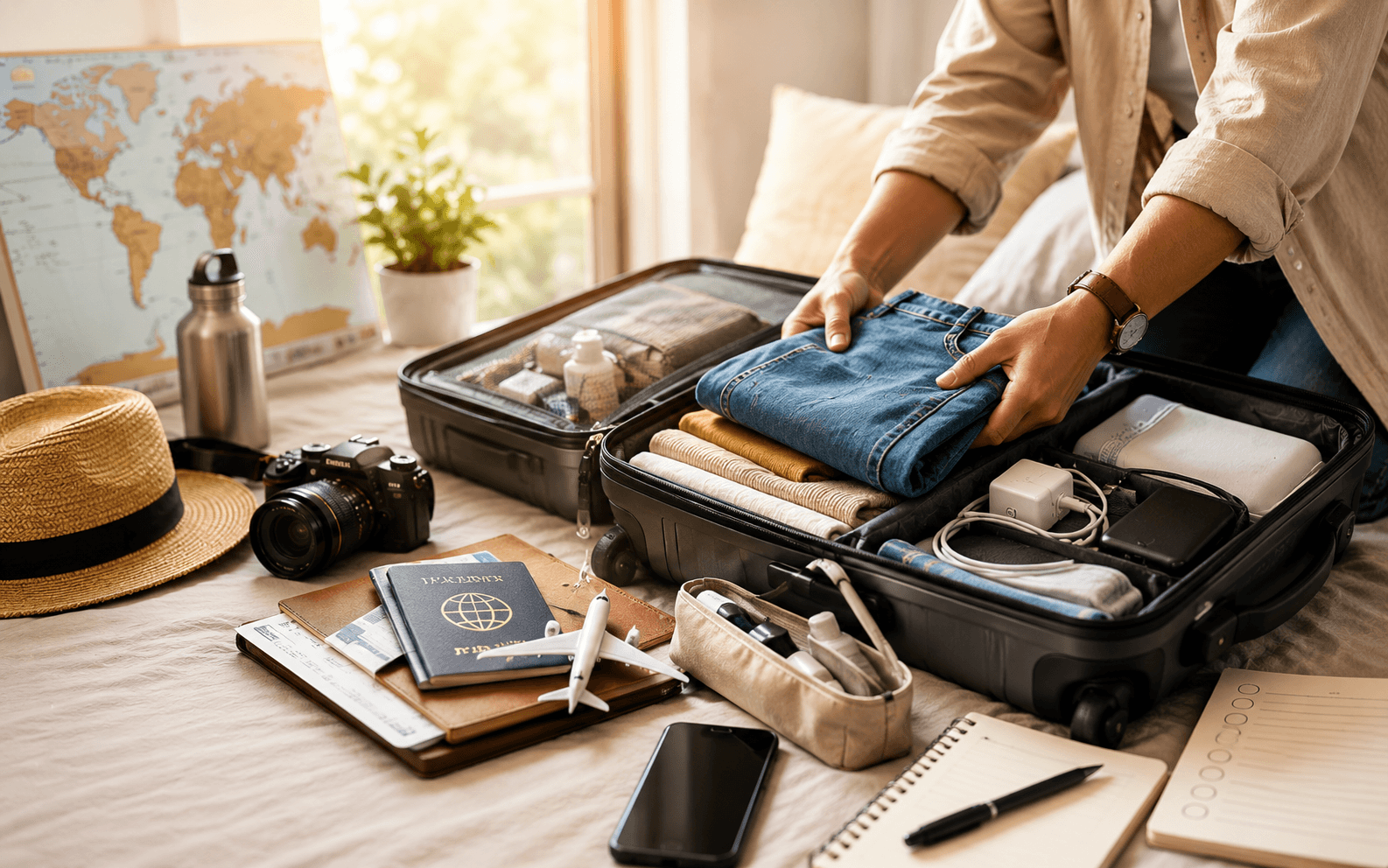
Leave roughly one-third of your suitcase empty before you even start folding. It feels wasteful in the moment, but it's the only way to bring anything back — souvenirs, a jacket you didn't expect to need, gifts you'll inevitably end up buying.
Weight limits catch more travelers than most packing lists admit. The typical international checked-bag limit sits around 23kg (50lbs), and exceeding it commonly costs several thousand rupees or its equivalent in excess fees per traveler — money that buys a genuinely nice dinner if it isn't spent at the check-in counter instead. Weighing your bag at home, on a cheap luggage scale, is a five-minute habit that avoids the surprise entirely.
Pack clothes you can layer rather than a separate outfit for every possible weather scenario — two or three base layers plus one warm layer and one rain layer cover far more ground than a suitcase full of single-purpose items. Rolling clothes instead of folding them saves noticeable space and makes it easier to see everything at a glance when you're digging for something specific.
Frequently Asked Questions
How much cash can I carry internationally without declaring it?
It depends on both your departure and destination country, but $10,000 USD or its equivalent is a common declaration threshold in many countries, including the US and EU. Some countries set the bar lower — always check both ends of your trip rather than assuming one rule applies everywhere.
Can I carry prescription medicines in checked baggage internationally?
Generally yes, but it's safer to keep medication in your carry-on in original packaging with a copy of the prescription, since some countries restrict specific medications regardless of which bag they're in. Check your destination's rules for controlled substances before you fly.
What's the TSA liquid limit in 2026?
The 3-1-1 rule remains unchanged for 2026: liquids, gels, and aerosols must be in containers of 3.4 ounces (100ml) or less, with all containers fitting into a single quart-sized clear bag.
The Takeaway
A packing checklist is only useful if it's current. The core list — passport, chargers, toiletries, a few changes of clothes — hasn't changed in years and won't change much going forward. What does change, quietly and often without warning, are the rules around money, batteries, and airport IDs that turn a smooth departure into an unexpected delay.
Run through this list against your specific trip — not just the country you're flying to, but the one you're flying from — and the parts that actually matter are the ones that were true this year, not the ones that were true five packing lists ago. For more first-trip fundamentals beyond packing, our guide for first-time international travelers covers the rest.


