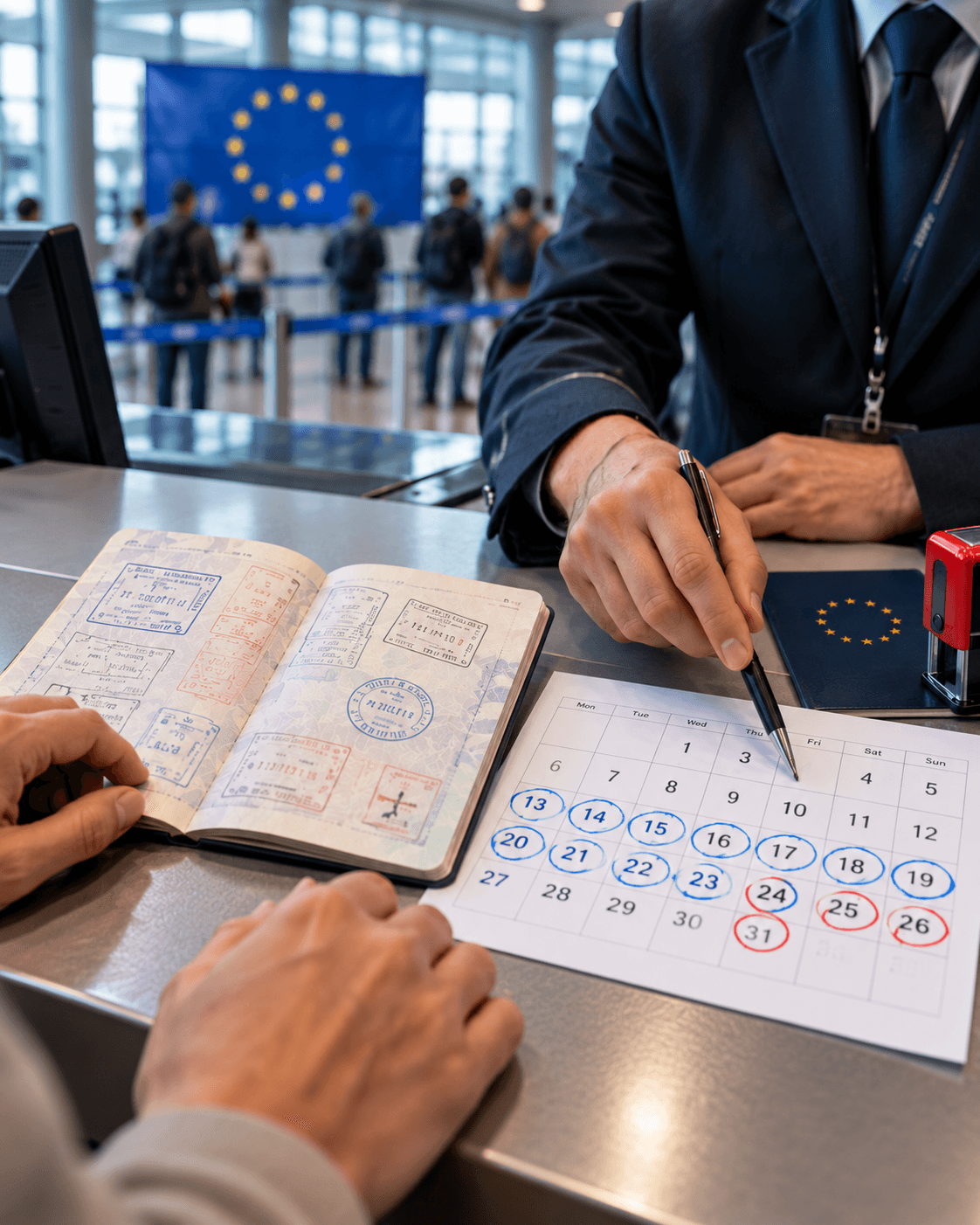

What Happens If You Overstay in Europe? Understanding the Schengen 90/180-Day Rule
The flight home is cheaper on Monday. Your 90th day is Sunday. Does one extra night really matter?
It’s an easy decision to make while planning a trip. So is adding a week in Spain after France, or assuming a short break outside Schengen gives you a fresh allowance. But changing countries doesn’t restart the clock. For most non-EU visitors on a short stay, the Schengen limit is 90 days across the whole area in any 180-day period. Separate holidays can count towards the same total.
So when does “one more night” become an overstay, and what happens next? Here’s how to count your days, understand the consequences and check your options if your plans change.
Last checked: . This is general travel information, not legal advice. Confirm your own position with the official sources linked below.
- Most non-EU visitors can spend up to 90 days in any 180-day period across all 29 Schengen countries combined. Arrival and departure days both count.
- Leaving the Schengen Area doesn't reset the clock. Each day you're in, look back over the previous 180 days and count again.
- EES now records entries and exits electronically, and flagged about 7,000 overstayers in its first six months. The EU's official tool shows how many days you have left.
- Consequences depend on the country and the case. They can include a fine, an order to leave, a record that affects future visas, or an entry ban. A new EU Return Regulation allows longer bans from October 2027.
What is the Schengen 90/180-day rule?
If you're a non-EU national visiting the Schengen Area for a short stay, whether you need a visa or travel visa-free, the general limit is 90 days in any 180-day period. The 180 days aren't a fixed six-month block that resets on a set date. They're a moving window, measured backwards from each day you spend in the area.
For every day you're in the Schengen Area, count that day and the 179 days before it. The number of days you were present in that window must never go above 90.
If your Schengen visa allows fewer days or a single entry, the visa's terms apply, not the general 90-day limit. Long-stay national visas and residence permits follow different rules.

How do you count your 90 days?
- List every date you entered and left the Schengen Area in the past six months.
- Count the day you arrive and the day you leave as full days, even if you land at 11pm.
- For each day of your planned trip, look back 180 days (including that day) and add up your Schengen days.
- Make sure the total never goes above 90, or the shorter limit on your visa.
Here is a worked example, based on three 30-day trips in 2026:
| Trip | Dates in the Schengen Area | Days used |
|---|---|---|
| Trip 1 | 1–30 March | 30 |
| Trip 2 | 1–30 May | 30 |
| Trip 3 | 1–30 July | 30 |
| Total by 30 July | All three trips fall inside the 180 days before 30 July | 90 (limit reached) |
This traveller can't come back the next day. The March days only start dropping out of the window at the end of August, so the earliest legal re-entry is 28 August 2026. Even then, they can only stay until 26 September. After that, the May and July days are still inside the window and the total hits 90 again.
The European Commission's short-stay calculator does this maths for you. Use it, but keep your own list of dates too.
Which countries count towards the 90 days?
The Schengen Area has 29 countries: 25 EU member states plus Iceland, Liechtenstein, Norway and Switzerland. Bulgaria and Romania became full members on 1 January 2025.
Ireland and Cyprus are in the EU but not in the Schengen Area. Days spent there don't count towards your Schengen total, and each has its own entry rules.
Moving between Schengen countries doesn't give you a new allowance. Twenty days in France, 25 in Italy and 15 in Spain add up to 60 Schengen days. If you need a visa, see our guide to the easiest Schengen country to get a visa from.

How do EES and ETIAS change things?
EES doesn't change the 90/180-day rule. It makes the rule much easier to enforce.
- EES (Entry/Exit System): started on 12 October 2025 and became fully operational on 10 April 2026. It registers non-EU short-stay travellers with fingerprints and a facial image, and records each entry and exit electronically in place of passport stamps. It calculates your remaining days automatically and flags overstays.
- How strict it is in practice: in its State of Schengen report (May 2026), the European Commission said EES identified about 7,000 overstayers in its first six months, along with 66 million recorded entries and exits.
- Checking your days: the EU's official "Check how long you can stay" tool on the Travel to Europe site shows your remaining authorised stay. Registration in EES is free, so ignore any website that charges for it.
- ETIAS: a separate pre-travel authorisation for visa-exempt travellers. It has been delayed to 2027 and isn't required yet. Even when it starts, it won't change the 90/180-day count. See our ETIAS update.
What happens if you overstay?
An overstay means remaining in the Schengen Area after your authorised stay ends. There is no single Europe-wide penalty: each country applies its own law. Authorities usually look at how long you overstayed, why, and your travel history.
Depending on the country and the case, possible outcomes include:
- A fine or administrative penalty under national law.
- A return decision, which is an order to leave by a set date.
- An entry ban, which is recorded in the Schengen Information System and applies across the whole area.
- A record in EES, which border guards and visa officers can see when you next apply or travel.
- In serious cases, detention or removal.
A short overstay won't automatically lead to a ban, but don't count on it being ignored either. With EES, the record exists whether or not anyone stops you at the border.
What changes under the new EU Return Regulation?
The EU has adopted a new Return Regulation, (EU) 2026/2280, published in October 2026. It replaces the 2008 Return Directive, and most of its rules on return decisions and entry bans apply from October 2027. Until then, each country keeps applying its current law.
Once it applies, the main changes for overstayers are:
- Entry bans of up to 10 years, or up to 20 in justified cases. Most bans under the old directive were capped at 5 years.
- A departure period of up to 30 days, or an order to leave immediately.
- A ban can be issued when an overstay is detected at exit checks, even after you have left.
- A common European Return Order that other EU countries can enforce.
Denmark has not adopted the regulation and isn't directly bound by it. If an overstay could affect you, check how it applies in the country concerned.
What if a cancelled flight or illness keeps you in Europe?
A cancelled flight or a hospital stay doesn't automatically extend your permission to stay. What helps is acting before your authorised stay runs out.
- Contact the immigration authority of the country you're in and ask about extending your stay. The Schengen rules let countries extend a short stay for serious personal reasons or force majeure. Extensions are granted case by case, so don't assume you'll get one.
- Keep written proof: the airline's cancellation notice, rebooking emails, medical certificates and hospital records.
- Book the earliest realistic departure and keep the receipt.
- If you're stuck at an airport, tell the border officer at exit control and show your evidence.
If your flight was cancelled, you may also be owed a refund or rerouting. Our guide to flight delay rights in the US, EU and UK explains what to claim.
Can you legally stay longer than 90 days?
Yes, but only through a specific route, never by "resetting" the clock.
- A long-stay national visa or residence permit from one country, for example for study, work or family reasons.
- A bilateral visa-waiver agreement. Some nationalities, including Australians and New Zealanders, have older agreements with individual countries such as Austria, Germany, the Netherlands and Sweden. These can allow extra time in that country on top of the 90 days. Australia's Smartraveller advises using only one agreement per trip, usually at the end of your Schengen travel, and telling the border guard on your first entry. Check the rules with that country's embassy, as each one applies its agreement differently.

What to do if you have already overstayed
- Check your dates. Use the EES tool or the Commission's calculator to confirm whether you have actually overstayed, and by how much.
- Don't ignore it. Under EES, the record is created when you exit whether you raise it or not. Leaving sooner usually helps.
- Contact the immigration authority of the country you're in, or get advice from a qualified immigration lawyer, especially if you have family, work or medical reasons for being there.
- Gather your evidence of anything that kept you from leaving.
- Before your next trip, check whether a ban or record exists, and declare it honestly on any future visa application.
How to avoid an accidental overstay
- Keep a running list of entry and exit dates. Since EES replaced stamps, your passport no longer shows them.
- Leave a buffer. Plan to leave a few days before the limit, so a delayed flight doesn't push you over.
- Recheck after every change. An extra stop or a later return flight changes the calculation.
- Remember Ireland and Cyprus don't count. They're useful for a break outside the Schengen count.
- Use official tools rather than forum advice: the EES checker, the Commission's calculator, and your own government's travel advice.
Frequently asked questions
Does leaving the Schengen Area reset the 90 days?
No. Time outside the area only helps because older Schengen days gradually drop out of the rolling 180-day window. Nothing resets.
Can I spend 90 days in France and then 90 days in Italy?
No. Both are Schengen countries, so days in each count towards the same 90-day limit.
Do the arrival and departure days count?
Yes. Both count as full days in the Schengen Area, whatever time you cross the border.
Does an overstay automatically mean an entry ban?
No. A ban is possible, and more likely for long overstays or if you don't leave when told to, but each country decides case by case. Under the new Return Regulation, from October 2027, bans can last up to 10 years.
How do I check how many Schengen days I have left?
Use the EU's official "Check how long you can stay" EES tool, or the European Commission's short-stay calculator with your own dates. Border guards can also tell you at passport control.
Are Ireland and Cyprus part of the 90/180-day count?
No. Both are EU members outside the Schengen Area, with their own entry rules.
Sources: European Commission short-stay calculator; EU Travel to Europe: Check how long you can stay; State of Schengen 2026 figures, reported 27 May 2026; Return Regulation (EU) 2026/2280 summary; Smartraveller: Schengen Area.


