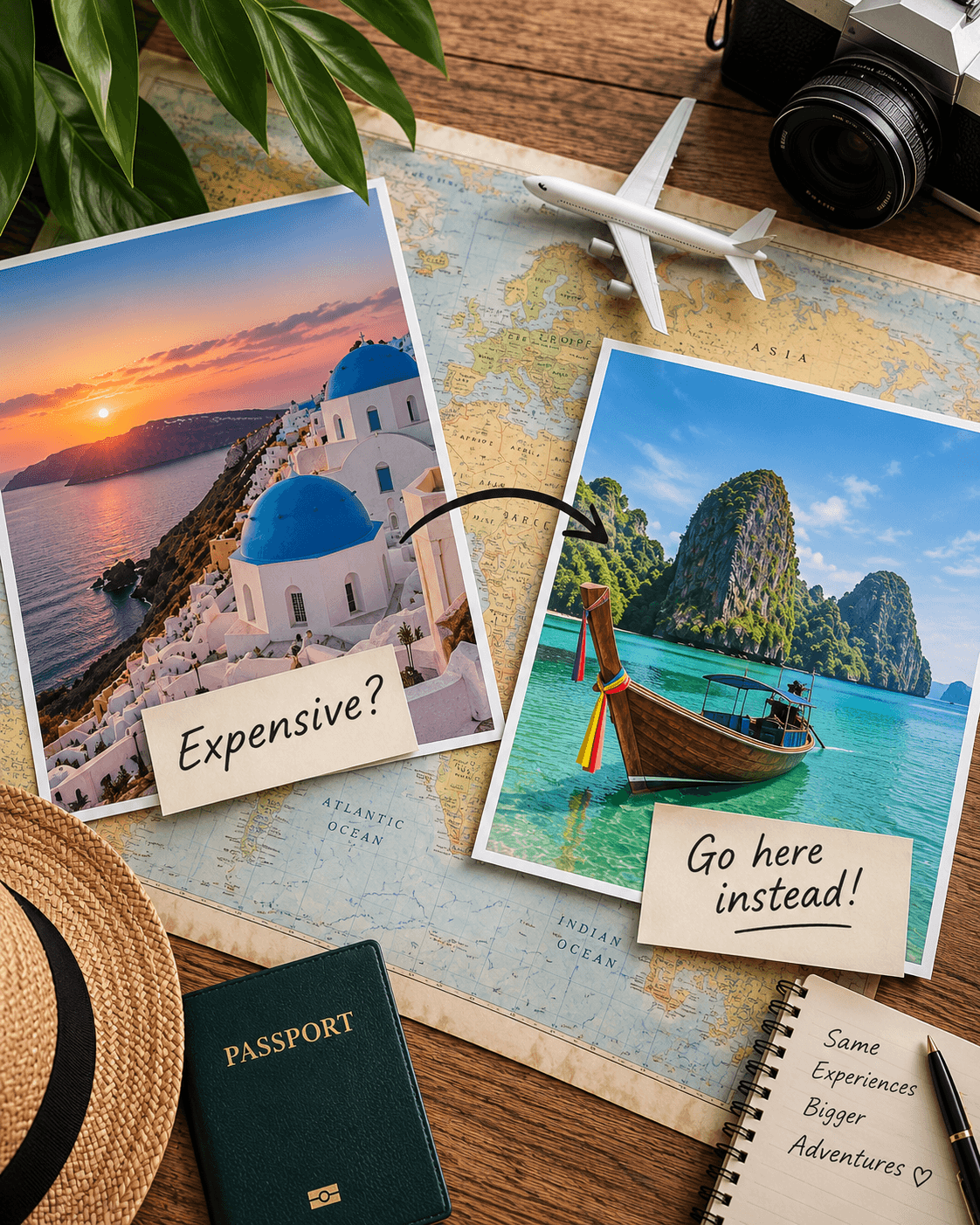
10 Destination Dupes for the World’s Most Expensive Travel Destinations
You picked a destination, checked the price, and quietly closed the tab. Then you searched for alternatives and found a dupe list. It was useless, because it was written for an American passport. Paros instead of Santorini is terrible advice when both need the same Schengen appointment you cannot get before March.
This list works differently. Every entry is a straight swap: a named expensive original, a named cheaper twin, and the entry rules for an Indian passport, because a destination you cannot get a visa for is not an alternative to anything. Some are easier to enter than the place you wanted. Two are not, and this post says so.
At a glance
- Biggest price gapMaldives to Sri Lanka
- Easiest to bookNepal: no visa, no fee, no form
- Needs checkingAlbania and Montenegro
- Newest changeUzbekistan announced visa-free entry on 30 August 2026
- Why do most dupe lists fail Indian travellers?
- Which expensive destinations have the cheapest swaps?
- Does a cheaper destination mean a worse trip?
- Which swaps are easiest on an Indian passport?
- Frequently asked questions
Why do most dupe lists fail Indian travellers?
A destination dupe is a cheaper place that delivers what you wanted from an expensive one. Expedia formalised the term in its 2024 trends report, naming pairs like Paros for Santorini and Sapporo for Zermatt.
Those pairs were built for passports that move freely. Swapping Santorini for Paros changes nothing about your paperwork: same appointment, same bank statements, same six-week wait. A dupe that works from India has to clear two bars: meaningfully cheaper, and no harder to enter.

Which expensive destinations have the cheapest swaps?
Entry rules below are for an Indian passport, checked in early September 2026. Visa policy moves fast, so confirm on the official government source before paying for anything.
- Nothing to apply for
- Apply online before you fly
- Depends on a visa you already hold
| Instead of | Go to | Indian passport status |
|---|---|---|
| Maldives | Sri Lanka | Visa-freeFree ETA, 30 days |
| Switzerland | Georgia | E-visaFree with a US, UK or Schengen visa |
| Santorini | Albania | E-visaSkip it only with a used multi-entry Schengen, US or UK visa |
| Bali | Vietnam | E-visa |
| Istanbul or Marrakech | Uzbekistan | E-visaVisa-free announced, not yet in force |
| Singapore | Kuala Lumpur, Penang | Visa-free30 days, expires 31 Dec 2026 |
| Tokyo | Taipei | ConditionalFree 14-day permit if eligible, else a visitor visa |
| Bora Bora | Palawan, Philippines | Visa-free14 days, non-extendible |
| Amalfi Coast | Bay of Kotor, Montenegro | Visa requiredUnless you hold a Schengen, US, UK or Irish visa |
| Queenstown | Pokhara, Nepal | No visa at all |
1. Maldives → Sri Lanka
Five nights in the Maldives runs ₹55,000 to ₹3,00,000, and transfers drive the swing. A seaplane alone is ₹15,000–25,000 each way. A week in Sri Lanka lands at ₹65,000–₹1,10,000. Since May 2026 the 30-day ETA has been free for Indians.
2. Switzerland → Georgia
Gudauri for snow, Kazbegi for Gergeti Trinity Church alone on a ridge below a 5,000-metre peak. The e-visa is USD 20 plus a USD 15 identity check that must be completed within 24 hours or the application dies. New for 2026: insurance covering 30,000 GEL is mandatory at the border.
3. Santorini → Albania
Ksamil for the water, Berat and Gjirokastër for the UNESCO stone towns. Albania is not unconditionally visa-free for Indians, whatever the reels say. That applies only if you hold a multiple-entry Schengen, US or UK visa already used once. Otherwise, a Type C e-visa.
4. Bali → Vietnam
The swap most Indian travellers already make. We have run the numbers separately in Bali or Vietnam: which is cheaper.
5. Istanbul or Marrakech → Uzbekistan
Samarkand does tilework, domes and a six-century bazaar without Istanbul’s crowds. Uzbekistan announced 30-day visa-free entry for Indians on 30 August 2026, but as of early September no effective date was published and the USD 20 e-visa still applied. Travel on current rules.

6. Singapore → Kuala Lumpur and Penang
Same skyline-and-hawker-food formula, lower hotel rates, plus a UNESCO old town in Penang. The 30-day exemption runs only to 31 December 2026 with no 2027 extension announced, and the free digital arrival card must be filed within 72 hours of landing.
7. Tokyo → Taipei
Night markets, mountains an hour out, transit like clockwork. You get Tokyo’s density without the prices our Japan trip cost guide puts at ₹1.6–2 lakh a week. Hold a US, UK, Japanese or Schengen visa and Taiwan’s Travel Authorization Certificate is free for 14 days; otherwise a visitor visa from ₹4,200.
8. Bora Bora → the Philippines
El Nido and Coron deliver limestone-and-lagoon scenery at Southeast Asian prices, with a non-stop Delhi–Manila route. All Indians get 14 days visa-free, 30 with a US, UK, Schengen or Japanese visa. But it is non-extendible, so plan two regions, not five.
9. Amalfi Coast → Montenegro
The Bay of Kotor is a mountain-ringed inlet with a walled medieval town at its base. Montenegro needs a visa from Indians unless you hold a Schengen, US, UK or Irish visa, which buys 30 days. Some sources say it must be multiple-entry, so check before flying.
10. Queenstown → Pokhara
Paragliding, bungee, a lake under the Annapurnas. The simplest international trip an Indian passport can make: no visa, no fee, no form, no stay limit. More in our visa-free countries guide.
Does a cheaper destination mean a worse trip?
Sometimes. There is no dupe for an overwater villa, and some experiences are expensive because they are genuinely scarce.
But the common case runs the other way. Sri Lanka is a country instead of a resort, with a train through tea country, leopards at Yala and a coastline, for less than the Maldives transfers alone. Between a narrower version of the famous trip and a wider version of the unfamiliar one, the dupe wins on everything except the photograph your colleagues will recognise. That is the actual trade. Not quality. Recognition.
Which swaps are easiest on an Indian passport?
Four terms get used interchangeably online and mean different things at a counter. Visa-free means you show a passport and walk through. E-visa means approved online before boarding. Visa on arrival means you queue and pay at the airport, which is still a visa. Visa required means an embassy or VFS appointment before you fly.
Notice how often a Schengen visa you already hold is the key. Albania, Montenegro, Georgia and Taiwan all get dramatically easier with one. If Europe is on the cards anyway, our guide to the easiest Schengen country to get a visa in 2026 is worth reading first, because that single application quietly buys you four more countries. Carrying cash across several of these? Check the cash limits on international flights from India.
So which one should you book?
Largest saving with least paperwork: Sri Lanka. Already hold a Schengen visa: Albania or Montenegro. Zero friction of any kind: Nepal.
The expensive destination is usually expensive because a lot of people decided at once that it was the one to go to. That is a reputation cost, and you are allowed not to pay it. Run both halves of a pair through Artictern’s cost-comparison flow before you commit. It prices your actual dates side by side, so you see the real gap rather than someone else’s average. That is usually the moment the second option stops being a compromise and starts being the plan.
Prefer to keep the famous destination and spend less there? See our list of destinations that feel expensive but aren’t.
Frequently asked questions
Which destination dupe saves Indian travellers the most money?
Sri Lanka instead of the Maldives. Five nights in the Maldives runs ₹55,000 to over ₹3,00,000 per person; a week in Sri Lanka typically costs ₹65,000 to ₹1,10,000, and the ETA is free.
Is Albania visa-free for Indian passport holders?
Not unconditionally. Only if you hold a valid multiple-entry Schengen, US or UK visa already used at least once. Everyone else applies for a Type C e-visa online before travelling.
Is Uzbekistan visa-free for Indians now?
Not yet. A 30-day regime was announced on 30 August 2026, but as of early September no effective date had been published and the e-visa still applied.
Which of these needs no visa at all?
Nepal: no visa, no fee, no form, no limit on stay. Sri Lanka, Malaysia and the Philippines are visa-free but still need a free online form or arrival card.


