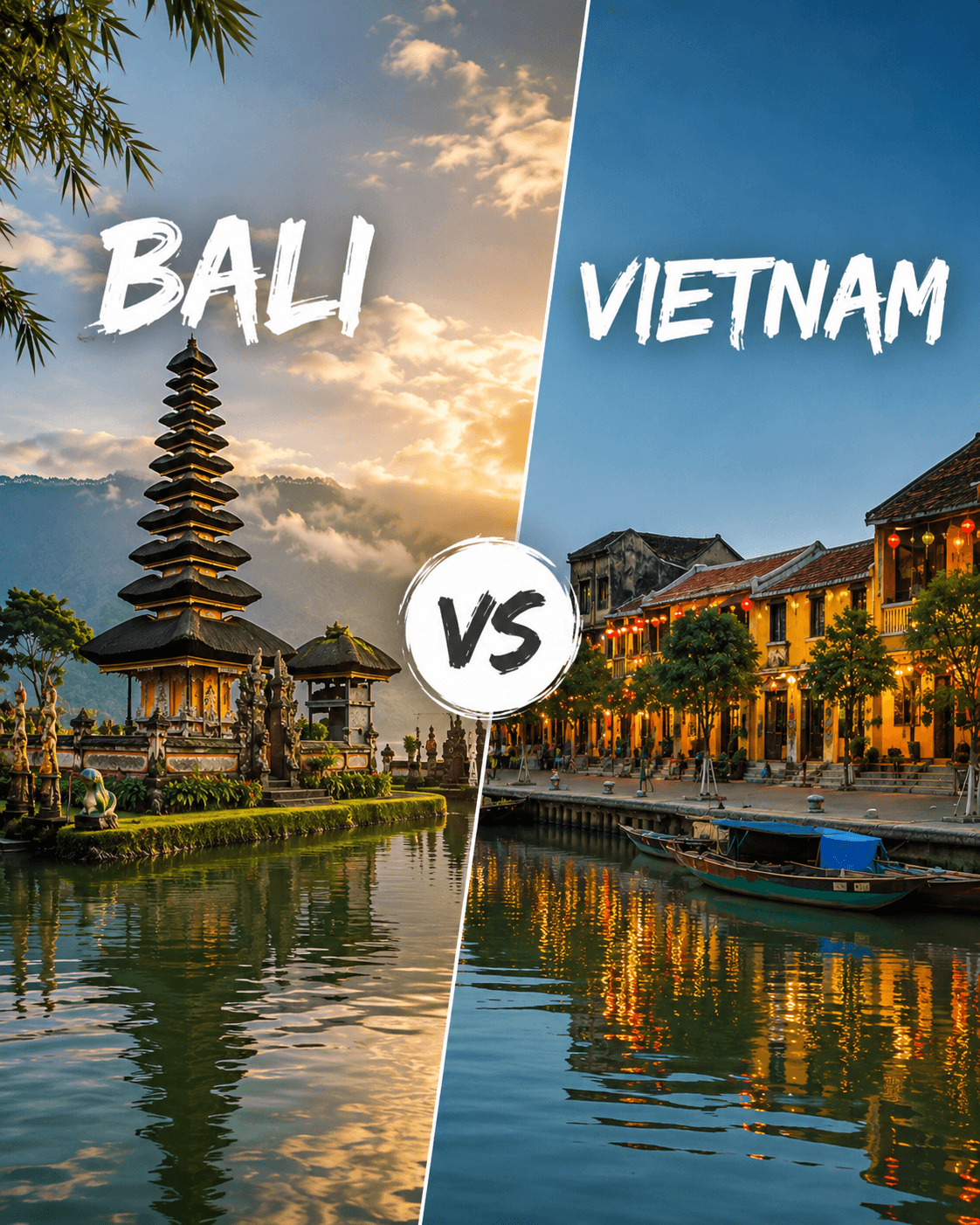
Bali or Vietnam: Which Is Cheaper for Indian Travellers
Open two browser tabs, one for Bali and one for Vietnam, and both will tell you the same thing. Cheap. Beautiful. Perfect for a first international trip. Neither will tell you which one leaves more money in your account when you land back at Delhi.
That is the actual question, and almost nobody answers it in rupees. The listicles price everything in dollars for a backpacker who stays three weeks. You are flying from Delhi or Mumbai for six or seven nights with a fixed number in your head, and you want to know whether Bali earns the extra spend or whether Vietnam quietly does the same job for less.
Short version: Vietnam is cheaper, and the gap is larger than most people assume. Longer version: the gap almost entirely disappears the moment you plan the trip the way Vietnam wants to be planned. Here is the arithmetic, line by line.
At a glance
-
Vietnam
Best monthsOct to Apr in the north, Feb to May for Da Nang
Daily budget, per person₹1,900 to ₹3,300 budget
₹4,300 to ₹9,000 mid-range The highlightStreet food that costs less than an auto ride home -
Bali
Best monthsApr to Jun and Sep to Oct, dry and just before peak
Daily budget, per person₹2,400 to ₹3,800 budget
₹6,700 to ₹12,400 mid-range The highlightOne base, no repacking, villa maths that works for groups
- Which is actually cheaper?
- How much do flights cost from India?
- What do the visa and entry fees really cost?
- What will you spend per day once you land?
- Why the cheaper country can still cost you more
- So which one should you book?
- Frequently asked questions
Bali or Vietnam: which is actually cheaper for Indian travellers?
Vietnam is cheaper. For a six-night mid-range trip from Delhi, budget roughly ₹50,000 to ₹60,000 per person for Vietnam against ₹75,000 to ₹85,000 for Bali. Most of that ₹25,000 gap is the flight and the daily spend. The visa difference is barely ₹1,200.
The six-night comparison, in rupees
Same trip shape for both: one return flight from Delhi, mid-range hotels, mostly local food, a couple of paid activities, insurance. No packages, no shopping.
| Line item | Vietnam | Bali |
|---|---|---|
| Return flight from Delhi | ₹16,000–25,000 | ₹25,000–40,000 |
| Visa and entry fees | ₹2,100–2,400 | ₹3,500 |
| 6 nights, mid-range | ₹30,000–36,000 | ₹45,000–54,000 |
| Travel insurance | ₹1,000–1,500 | ₹1,000–1,500 |
| Realistic total | ₹50,000–60,000 | ₹75,000–85,000 |
Planning ranges, not quotes. Fares move weekly and both currencies move daily. Check live prices for your dates.
Where the gap actually comes from
- Flight up to ₹15,000
- 6 nights up to ₹18,000
- Visa ₹1,200
- Insurance ₹0
How much more Bali costs on each line. Two rows do nearly all the work, and they happen to be the two you control.
The visa difference is a single dinner. The insurance is identical. Shift your dates and the flight moves by ₹10,000. Eat at warungs instead of cafes and the daily line moves by ₹2,000. The verdict is real, but it is not fixed.

How much do flights to Bali and Vietnam cost from India?
Return fares from Delhi to Hanoi or Ho Chi Minh City typically run ₹16,000 to ₹25,000, with advertised lows near ₹11,500 one way. Delhi to Denpasar runs ₹25,000 to ₹40,000. Vietnam is closer, has more direct flights, and is cheaper on almost every date.
The direct-route advantage
Vietnam is now one of the best-connected countries in Southeast Asia for Indian flyers. IndiGo, VietJet and Vietnam Airlines fly direct from Delhi to Hanoi, 36 flights a week as of July 2026, averaging four hours ten minutes. Ho Chi Minh City is busier still: VietJet, Air India and EVA Air fly it direct, 40 weekly departures as of August 2026.
That density shows up in the fares. Ho Chi Minh City starts around ₹11,495, cheapest in August, September and October, and Delhi to Hanoi averages roughly ₹22,500 with lows near ₹14,240. Four hours is also short enough to leave after work and land the same night, which a spreadsheet will not show you.
Why Bali costs more before you land
Air India and IndiGo fly Delhi to Denpasar direct, 17 flights a week as of July 2026, just under eight hours. Fewer seats, longer sector, higher fare. Short-notice fares in late August 2026 started around ₹27,800, and typical January fares sit at ₹23,500 to ₹32,500, the cheapest month on the route.
Connecting via Kuala Lumpur or Singapore brings the fare down. You pay for it in a nine to eleven hour door-to-door day, and that layover feels far longer on the way home than it did on the way out.
What do the visa and entry fees really add up to?
Vietnam costs USD 25, around ₹2,100 to ₹2,400, for a 90-day single-entry e-visa. Bali costs IDR 500,000, roughly ₹2,700, for the e-VOA, plus a mandatory IDR 150,000 tourist levy, about ₹800. Budget ₹3,500 for Indonesia and ₹2,300 for Vietnam.
Indonesia's e-VOA and the levy nobody mentions
India is not on Indonesia's visa-exemption list, so every Indian passport holder needs the visa on arrival or the e-VOA applied for online. The fee is IDR 500,000 for 30 days, extendable once, and the Bali Tourist Levy of IDR 150,000 is separate and payable even if you hold a valid VOA. That second charge is the one that surprises people at the counter.
Pay both online before you fly. Direct flights from Delhi and Mumbai have made the manual counters at Ngurah Rai congested, and a pre-approved e-VOA lets you walk straight to the biometric autogates. Our guide to visa-free countries for Indian passport holders is worth a look. Neither of these qualifies, but plenty of others do.
Vietnam's USD 25 e-visa, and the Phu Quoc exemption
Vietnam's e-visa fee is USD 25, roughly ₹2,100, with processing of three to five working days. It has been open to all nationalities including Indians since 15 August 2023, and validity runs up to 90 days. You apply yourself at evisa.gov.vn. Anyone quoting ₹7,000 for a standard tourist visa is selling you a form you can fill in for free.
Now the part that looks like free money and is not. Phu Quoc island offers Indians 30 days visa-free if you fly in directly and leave directly. Skipping the visa saves you ₹2,100. It also strips your legal ability to reach a mainland hospital.
The Consulate General of India in Ho Chi Minh City has advised that the exemption is strictly limited to travel within Phu Quoc and does not permit entry into mainland Vietnam. Indian nationals have been forced to travel to Ho Chi Minh City or Hanoi for medical treatment or onward travel after flight disruptions, facing delays and immigration complications without a valid visa.
The same advisory notes that after a lost passport, an exit permit from Vietnamese authorities usually takes three to five working days, during which you must remain in the country. The embassy's own advice is to buy the visa anyway. At ₹2,100, treat it as insurance rather than a fee.
What will you actually spend per day once you land?
Day one in Hanoi breaks something in an Indian traveller's head. A bowl of pho costs less than the auto fare to the station. You order a second out of disbelief. Bali's first evening usually goes the other way. The beach club looked reasonable on Instagram, and the bill arrives with tax and service stacked on a menu price that already felt like Mumbai.

| Vietnam | Bali | |
|---|---|---|
| Hostel dorm | USD 5–12 | Comparable at the budget end |
| Budget private room | USD 15–30 | USD 25–50, usually larger |
| Local meal | Pho USD 1.50–3 | Warung cheap, sit-down USD 14–29 |
| Budget day total | USD 20–35 | USD 25–40 |
| Mid-range day total | USD 45–95 | USD 70–130 |
The starkest comparison is food. A Vietnamese street meal costs a fraction of a Bali sit-down bill. Transport is a wash: Grab works across both, scooters rent for pocket change, and in both countries the roadside taxi is the expensive mistake.
The costs that never show up in the daily rate
Menu prices in tourist areas are usually quoted before tax and service. The first charge is a service charge set by the business, commonly 5% to 11%, which is distributed to staff and cannot legally be kept as company income. The second is PB1, a regional tax collected by the regency rather than the central government, commonly 10%, charged under Indonesia's regional taxes law.
The catch is that the service charge is itself taxable, so the two compound rather than simply adding. Ten plus ten does not give you 20%, it gives about 21%. That is why "++" and "subject to 21%" appear so often on Bali menus and hotel rates. A price marked "net" already includes both. Warungs and small local places commonly charge neither, which is a large part of why eating local in Bali saves more than it does elsewhere.
Currency. Neither the rupiah nor the dong is easy to buy in India. The usual advice is to convert rupees to US dollars here, then dollars to local currency after landing. Know your limits before you pack: our guide to cash limits on international flights from India covers what you can legally carry in both directions.
Insurance. A week's cover runs ₹1,000 to ₹1,500, and both destinations are scooter countries, which is exactly where a skipped policy becomes an expensive decision. Our complete guide to travel insurance covers what cover you actually need.
Why the cheaper country can still cost you more
Here is the part that trips up almost everyone who plans this comparison on daily rates alone. Vietnam is cheaper per day. Vietnam is also a country that quietly refuses to be a six-night trip.

Vietnam is a ten-day country. Bali is a six-day island.
Vietnam's geography is linear, roughly 1,610 km from Hanoi to Ho Chi Minh City, which makes a north-to-south route natural. Indonesia's islands demand flights or ferries. That reverses the usual assumption: Bali keeps you on one island with one base and a scooter, while Vietnam pulls you into Hanoi, then Da Nang and Hoi An, then Ho Chi Minh City, and each hop is a fare.
Booked two to three weeks ahead, Hanoi to Da Nang runs USD 25 to 60 and Ho Chi Minh City to Da Nang USD 25 to 55. Sleeper buses do the same corridors for USD 10 to 25. Add two hops and four extra nights to that six-night Vietnam trip and you land at roughly ₹75,000 to ₹90,000, the exact bracket the six-night Bali trip occupies.
It is not "Vietnam is cheaper than Bali." It is: Vietnam costs less per day, and tempts you into more days. Both trips are good value. They are just different-shaped purchases.
If a longer stay appeals, several of the cities involved, Da Nang especially, appear in our roundup of countries making it easier for digital nomads to live and work, where the per-day arithmetic changes again.
Two people versus four changes the answer

Bali's market is built around whole villas, and a three-bedroom villa split between four undercuts four separate hotel rooms almost anywhere else. Vietnam is the mirror image: dense, cheap, per-person hostels that serve solo travellers and pairs far better than groups.
One last India-specific line. Budget 2026 cut TCS on overseas tour packages to a flat 2% from the first rupee, replacing the earlier 5% and 20% structure, effective 1 April 2026. Standalone flight tickets attract no TCS, only bundled packages do, and TCS is creditable against your income tax when you file your ITR. It is a cash-flow item rather than a cost, and at 2% it no longer decides anything.
So which one should you actually book?
-
First international trip, six or seven nights, want it easy
Bali
One flight, one base, one unpacking, and an island whose infrastructure does most of the thinking for you. That simplicity costs about ₹25,000 more per person, and for plenty of people it is worth every rupee.
-
Tight budget, want maximum trip for the money
Vietnam
Cheaper flights, cheaper food, cheaper rooms, and a country where the good stuff is often free to walk through.
-
Group of four, or a honeymoon
Bali
The villa arithmetic flips the comparison, and Ubud remains the wellness and spa capital of the region in a way Vietnam does not attempt.
-
Solo, ten days or more, want to keep moving
Vietnam
The hostel network is dense, the north-to-south route is well worn, and moving every third day is normal rather than heroic. The sort of trip our list of places every solo traveller should experience once is built around.
Frequently asked questions
Is Vietnam cheaper than Bali for Indian travellers?
Yes. For a comparable six-night mid-range trip from Delhi, Vietnam runs roughly ₹50,000 to ₹60,000 per person against ₹75,000 to ₹85,000 for Bali. Flights and daily spend account for nearly the whole difference.
Do Indians need a visa for Bali and Vietnam?
Both. Indonesia issues a 30-day e-VOA at IDR 500,000 plus an IDR 150,000 Bali tourist levy. Vietnam issues a 90-day e-visa at USD 25 through evisa.gov.vn. Phu Quoc island alone offers 30 days visa-free to direct arrivals, with significant restrictions.
Which has cheaper flights from India?
Vietnam, clearly. Delhi to Hanoi is a four-hour direct hop with 36 weekly flights and fares from around ₹14,000, while Delhi to Denpasar is nearly eight hours with 17 weekly flights and fares typically starting above ₹25,000.
What does "++" mean on a Bali menu?
That the price excludes service charge and PB1 regional tax. The service charge is commonly 5% to 11% and the tax commonly 10%, and because the service charge is itself taxable they compound to roughly 21% rather than adding to 20%. A price marked "net" already includes both.
How many days do you need in each?
Bali works well in five to seven nights from a single base. Vietnam realistically wants nine or ten if you intend to see the north, the centre and the south, which is exactly why the total cost converges.
You now have two numbers. The harder part is holding them together.
Flights move weekly, the rupiah and the dong move daily, and the difference between a ₹55,000 trip and an ₹85,000 one is usually four or five decisions made across three weeks.
Artictern keeps the whole thing in one place: your dates, your fares, your visa fees and your daily spend, converted into rupees as you build it, so you can watch the total move when you change one line. Build both trips. Then book the one you actually want, knowing exactly what it costs.
Related reading
- Japan trip cost from India The same rupee-first breakdown for a pricier destination
- 10 destination dupes Cheaper twins for the world's most expensive hotspots
- Destinations that feel expensive but aren't If neither of these is the trip


