Best Festivals Around the World Worth Traveling For
Best Festivals Around the World Worth Traveling For
Most "best festivals in the world" lists are photo bait. They pile on saturated colors and confetti and call it a list, without asking the only question that actually matters: would you build an entire trip around this, or just stumble into it on the way to somewhere else?
These eight pass that test. Each one is the reason to book the flight, not a stop tacked onto a longer itinerary. Read through them in order — January to November — and by the end, planning a whole year around festivals instead of destinations starts to look less like a gimmick and more like the smartest way to travel.
| Festival | Timkat | Rio Carnival | Holi | Songkran | La Tomatina | Burning Man | Oktoberfest | Día de los Muertos |
|---|---|---|---|---|---|---|---|---|
| Country | Ethiopia | Brazil | India | Thailand | Spain | USA | Germany | Mexico (Oaxaca) |
Timkat, Ethiopia — January's Best-Kept Secret

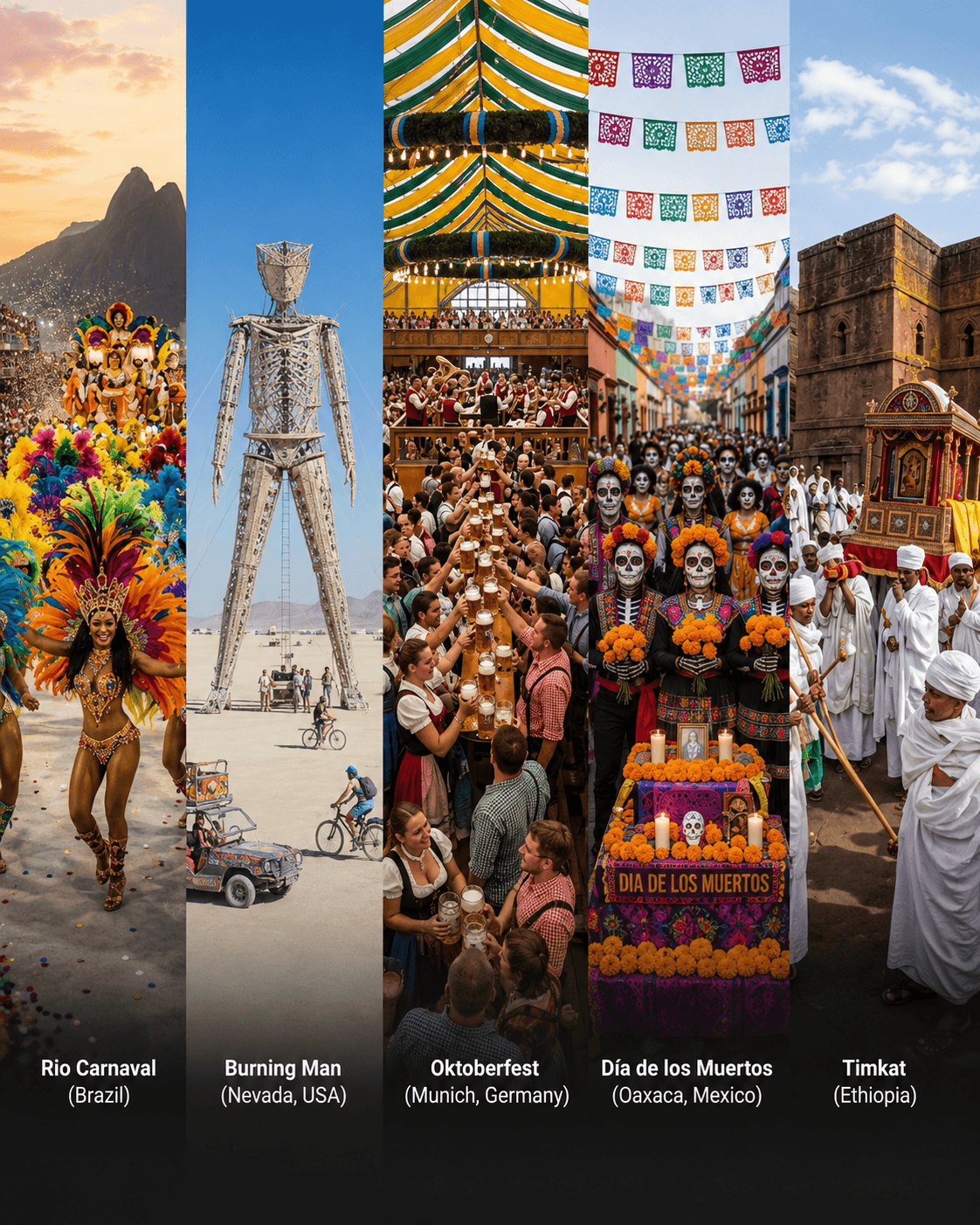
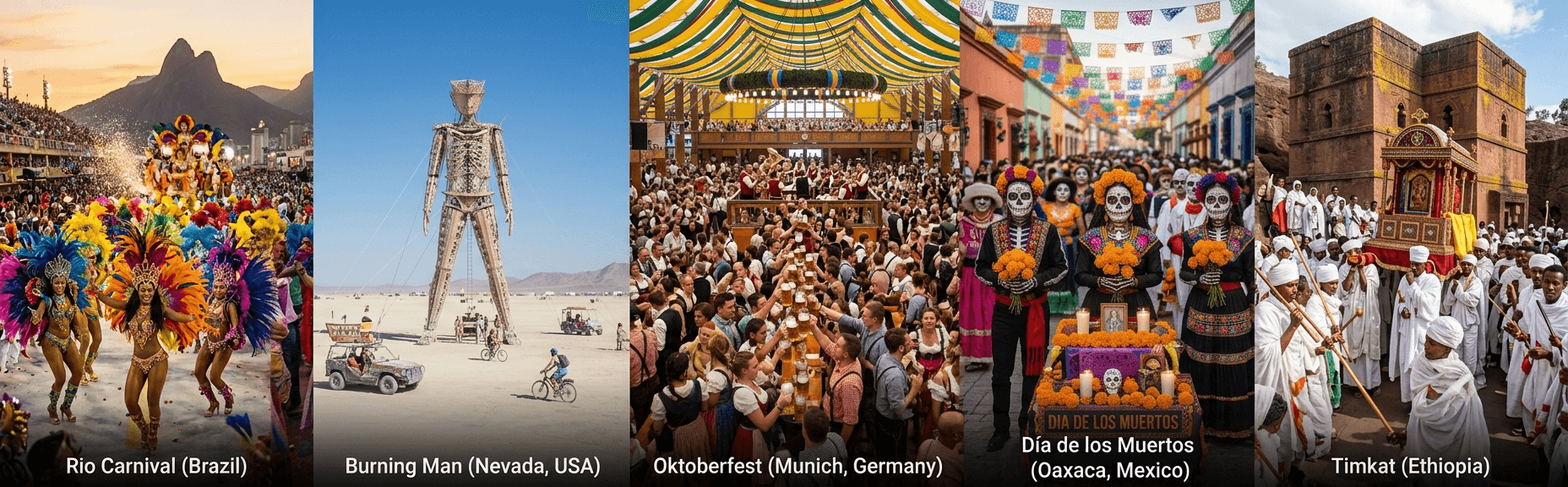
Timkat falls on January 19, 2026, marking Ethiopian Epiphany—the day the Ethiopian Orthodox Tewahedo Church commemorates the baptism of Jesus in the Jordan River. Widely considered one of Ethiopia's most vibrant and visually spectacular festivals, Timkat remains relatively unknown to many international travelers despite its UNESCO-recognized cultural significance.
The festival centers on the Tabot, replicas of the Ark of the Covenant kept in every Ethiopian Orthodox church, which are wrapped in embroidered cloth and paraded through the streets the night before to crowds gathering near a pool or river. Priests in elaborate robes lead processions through streets packed with worshippers dressed in white shamma, the traditional cotton wrap. The following morning, crowds gather for a mass baptismal blessing, water sprayed or poured over the assembled faithful in a scene that feels both ancient and completely alive.
Addis Ababa hosts a major celebration, but Gondar and Lalibela — with their centuries-old rock-hewn churches — offer a more intimate, less touristed version of the same ritual.
Rio Carnival, Brazil — The Festival Every Other Festival Gets Compared To

Rio Carnival runs February 13–17, 2026—the five days leading up to Ash Wednesday. While Carnival traditions began centuries before Brazil, Rio transformed the celebration into the world's most iconic Carnival, becoming the global benchmark for elaborate costumes, samba parades, and street celebrations.
The Sambadrome parades are the headline event — samba schools compete through the night with elaborate floats, thousand-person casts, and choreography rehearsed for months, judged on everything from drumming to costume design. But the real Carnival happens outside the stadium, in the blocos — free street parties that take over entire neighborhoods, some drawing hundreds of thousands of people behind a single truck blasting samba and marchinha.
Budget travelers can experience the spectacle from the arquibancadas, the general-admission grandstand seats, for a fraction of the price of the reserved boxes — the view is nearly as good, and the crowd energy is arguably better.
Holi, India — Worth Going Beyond Mathura and Vrindavan For

Holi falls on March 4, 2026, and most international coverage points travelers toward the same two towns — Mathura and Vrindavan, where the festival's Krishna mythology runs deepest and the celebrations stretch across an entire week rather than a single day.
Barsana's Lathmar Holi, held a few days before the main event, flips the usual color fight into something closer to theater: women chase men through the streets with sticks, reenacting a local legend, while the men defend themselves with shields, all of it soundtracked by folk singers. Pushkar and Jaipur offer a calmer, more manageable version for first-time visitors, with organized color-throwing events that don't require navigating the sheer crowd density of Mathura's temple lanes.
Wherever it's celebrated, Holi runs on the same principle: strangers become temporary co-conspirators, color washes out every visible marker of status, and by afternoon the whole street looks like a spilled paint box. For lesser-known spots to build a Holi trip around, our guide to India's hidden gems covers a few worth the detour.
Songkran, Thailand — Thai New Year as a Nationwide Water Fight

Songkran runs April 13–15 every year, marking the traditional Thai New Year, and it turns entire cities into a coordinated three-day water fight. The origin is gentler than the modern version suggests — a ritual of pouring water over Buddha statues and the hands of elders as a gesture of respect and purification, washing away the past year to start the new one clean.
Chiang Mai is widely considered the best base for it — the old city's moat becomes a continuous water-scooping relay, pickup trucks patrol the streets with barrels in the back, and the entire population seems to agree, silently, that nobody is exempt. Bangkok's Khao San Road version is louder and more chaotic, better suited to travelers who want the party version over the ritual one.
Waterproof phone pouches aren't optional. Neither is accepting, completely, that you will be soaked within the first ten minutes and dry within the hour, over and over, for three straight days.
La Tomatina, Spain — One Hour, Thousands of Tomatoes

La Tomatina takes place on the last Wednesday of August — August 26, 2026 — in the small town of Buñol near Valencia, where thousands of participants throw over 100 tons of overripe tomatoes at each other in a single chaotic, joyful hour.
The fight started as a spontaneous scuffle among friends in 1945 and somehow calcified into an annual tradition, complete with a firework signal to start and another to end it exactly sixty minutes later. Tickets have been required since 2013, capped at 20,000 participants, since the event outgrew what the town's narrow streets could handle.
The mechanics are simple and completely absurd: trucks dump ripe, squashed tomatoes into the street, and for one hour the entire town becomes an edible battlefield. Streets run red, clothes are ruined beyond recovery, and by the time the second firework goes off, the local fire brigade is already hosing down the buildings. Book accommodation in Valencia rather than Buñol itself — the town is tiny, and most participants commute in for the day.
Burning Man, Nevada — Not a Festival, a Temporary City

Burning Man runs from August 30 to September 7, 2026, in Nevada's Black Rock Desert, where roughly 70,000 participants build Black Rock City from scratch each year. Guided by a strict Leave No Trace ethic, they create a temporary community devoted to art, self-expression, and participation before the festival culminates with the burning of a massive wooden effigy on the second-to-last night.
Calling it a music festival undersells what actually happens. Burning Man operates on a gift economy — no money changes hands on the playa except for ice and coffee — and every structure, from massive art installations to sound camps, is built and then completely dismantled afterward, leaving no visible trace in the desert.
The scale is disorienting in person: art cars the size of buses roams the open playa at night, lit like moving sculptures, while temporary theme camps offer everything from sunrise yoga to full sound systems running until dawn. The climax is the burning of the namesake wooden man on the penultimate night, followed by the Temple burn the following evening — a quieter, more reflective counterpart built for grief and release rather than celebration.
It's not a festival for casual attendees. Extreme desert heat, dust storms, and a self-reliance ethic that expects participants to pack in everything they need make it one of the more demanding events on this list.
Oktoberfest, Munich — Older and Stranger Than the Beer Suggests

Oktoberfest 2026 runs September 19 to October 4 on Munich's Theresienwiese, marking the festival's 191st edition — and the origin story has almost nothing to do with beer. It began in 1810 as a public celebration of Crown Prince Ludwig's wedding to Princess Therese of Saxony-Hildburghausen, capped off with a horse race that the citizens of Munich enjoyed enough to repeat the following year.
Two centuries of accretion later, it's the world's largest Volksfest, drawing over six million visitors into 17 large tents and 21 smaller ones, each with its own personality — Hofbräu draws the loudest international crowd, Schottenhamel hosts the ceremonial keg-tapping that opens the festival each year, and the smaller family tents offer a calmer, walk-in-friendly alternative during the day.
Entry to the Oktoberfest grounds is free; it's the beer tents where reservations become valuable, especially for evenings and weekends when many tables are booked months in advance. If you're planning to return in future years, consider investing in a well-made dirndl or pair of lederhosen rather than a novelty costume—they're more authentic, better constructed, and commonly worn by locals.
Día de los Muertos, Oaxaca — A Celebration of Life Wearing Death's Clothes

Día de los Muertos is observed on November 1–2, 2026, with Oaxaca hosting one of Mexico's most elaborate and internationally celebrated observances. Across several days, families build marigold-covered ofrendas, hold candlelit cemetery vigils, and welcome the spirits of departed loved ones back for a visit—a tradition centered on remembrance, love, and celebration as much as loss.
The tradition fuses pre-Hispanic Indigenous ritual with the Catholic All Saints' and All Souls' days brought by Spanish colonizers, and what survived the merger is unusually honest about death — not an ending, but a temporary visit, and one worth throwing a party for.
Oaxaca's celebrations stretch from October 31 through November 2, anchored by nightly comparsas — street parades of dancers and musicians dressed as skeletons and catrinas — and cemetery vigils where families cook meals at gravesites and sleep beside them through the night, brass bands playing until dawn. Sand tapestries appear overnight in the zócalo, elaborate enough to look museum-made, and every home, restaurant, and public building builds its own ofrenda, an altar stacked with photos, candles, and a deceased relative's favorite foods.
Hotels in Oaxaca fill completely for these dates and rates commonly triple, so this is one festival on this list that genuinely needs booking six months out, not six weeks.
Frequently Asked Questions
What's the best festival to travel to for a first-timer?
Songkran or Holi both work well for a first festival trip — both are joyful rather than solemn, don't require advance tickets the way La Tomatina or Burning Man do, and the worst that can happen is you get soaked or covered in color.
Do these festivals need to be booked far in advance?
Yes, most of them. La Tomatina and Burning Man both cap attendance and sell out early, and Oaxaca's Día de los Muertos hotels routinely book out six months ahead with rates tripling. Rio Carnival and Oktoberfest need early hotel bookings even though the events themselves don't require tickets to attend the streets or grounds.
Which festivals need a visa for Indian travelers?
Most of these do — Brazil, Ethiopia, the United States, Germany, Spain, and Mexico all require some form of visa or entry authorization for Indian passport holders, while Thailand currently offers visa-free entry. Our visa guide for Indian travellers breaks down the requirements for each.
The Takeaway
None of these eight need each other to justify the trip. That's the point — each one, on its own, is worth building an entire itinerary around, flights and all, rather than squeezing in as a detour from somewhere else.
Plan a year around a few of these instead of a year around destinations, and the trips stop being about ticking off a place and start being about showing up for something that's actually happening — a ritual, a party, a temporary city that won't exist in the same form next year. That's a different kind of travel than most people default to, and it tends to be the kind people actually remember.


