Why Are 47% of UNESCO World Heritage Sites in Europe?
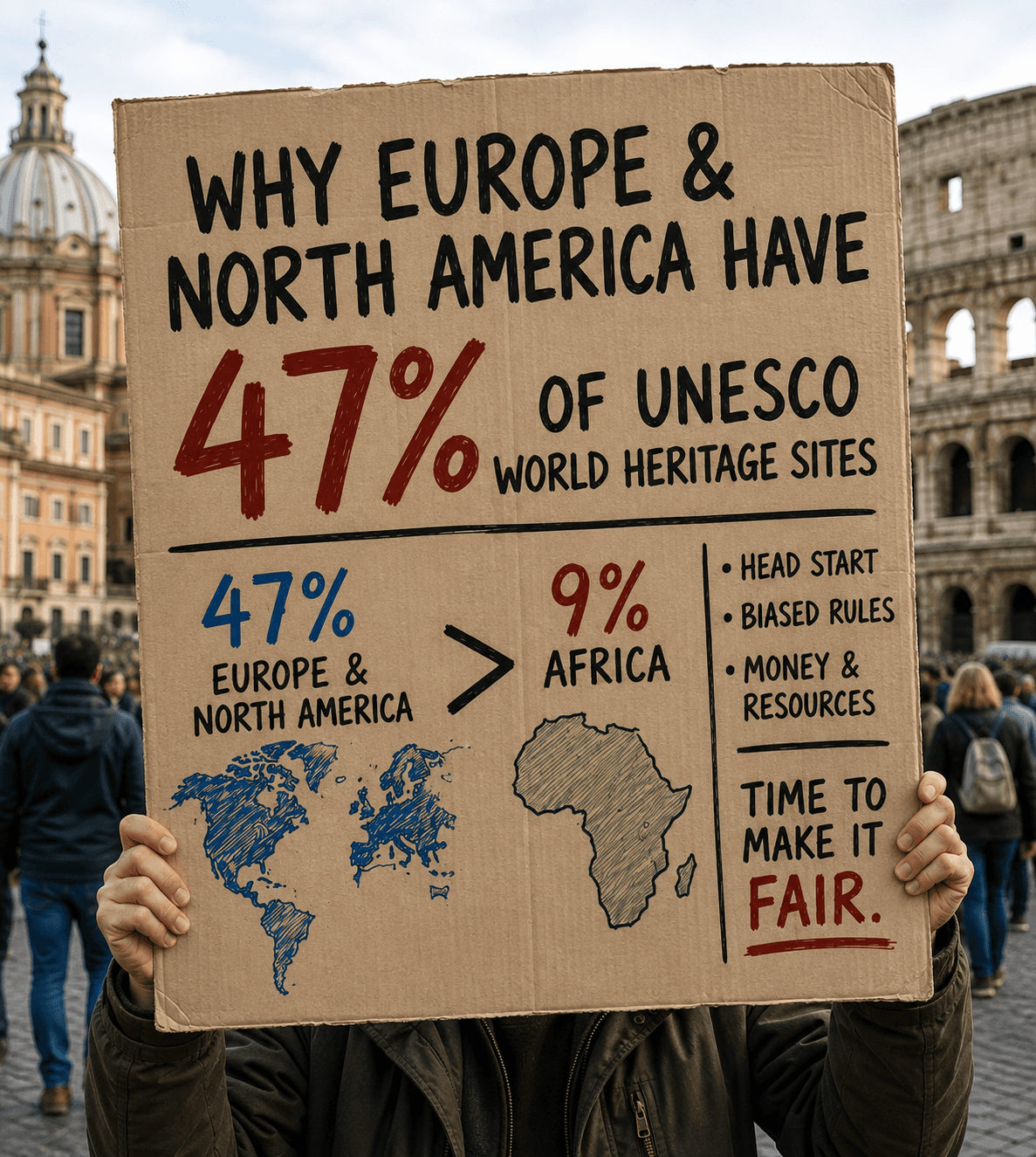
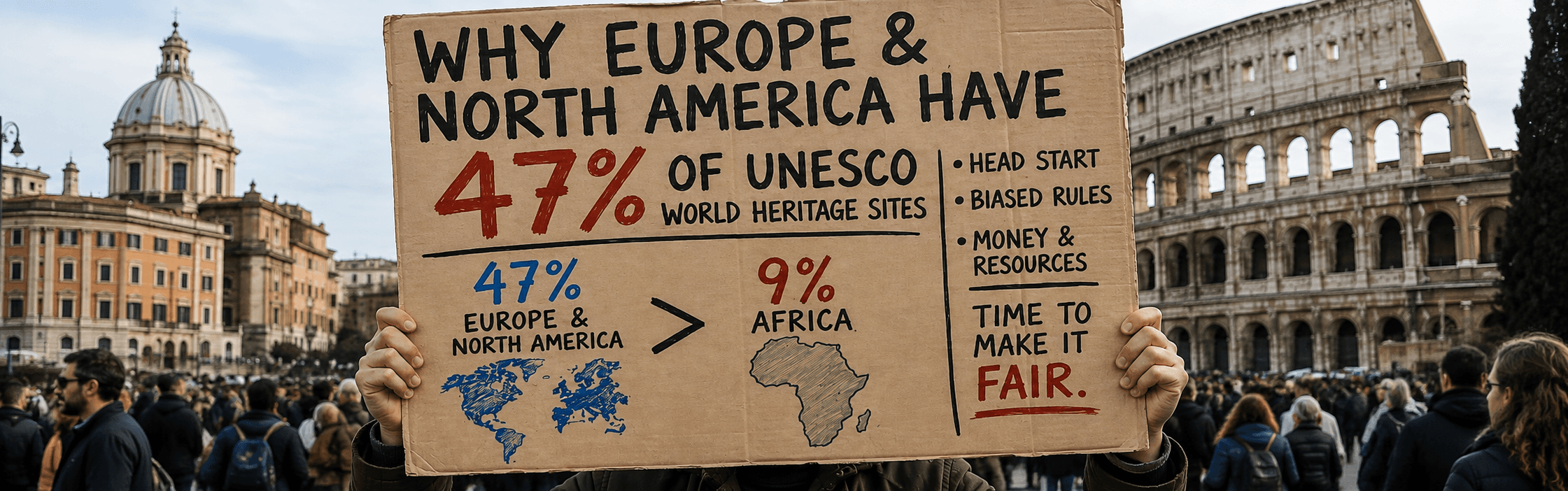
Africa is roughly the same size as Europe and North America combined. Africa holds about 9% of UNESCO World Heritage Sites. Europe and North America hold close to 47%. Same land area, wildly different number of sites on the list.
That "47%" number gets repeated a lot, but it's usually slightly misquoted. It isn't just Europe. It's Europe and North America lumped together, which is the exact category UNESCO itself uses in its official statistics. Split them apart, and Europe on its own is still the single biggest region on the list, just not quite the number the headline implies.
Either way, it's a strange fact to sit with. Does Europe genuinely have that much more "outstanding universal value" lying around than the rest of the planet? Not really. What it has is a fifty-year head start, and a set of rules that, for a long time, happened to fit European history unusually well. Here's the actual breakdown, and the reasons behind it, checked against UNESCO's own data.
So How Many Sites Are Really in Europe?
UNESCO's World Heritage List currently holds 1,248 sites across 170 countries. Here's exactly how that splits by region, straight from UNESCO's own published statistics:
| Region | Number of Sites | Share of the List |
|---|---|---|
| Europe and North America | 580 | 46.5% |
| Asia and the Pacific | 306 | 24.5% |
| Latin America and the Caribbean | 153 | 12.3% |
| Africa | 112 | 9.0% |
| Arab States | 97 | 7.8% |
Zoom into individual countries and it gets even more lopsided:
- Italy: 61 sites
- China: 60 sites
- Germany: 55 sites
- France: 54 sites
- Spain: 50 sites
Add up just those top four European countries, Italy, Germany, France, and Spain, and you already beat the combined total of every site in Africa and the Arab States, over 50 countries, put together.
Reason 1: Europe Showed Up Early, Paperwork Ready

UNESCO's World Heritage program started in 1972. Getting a place added isn't quick. A country has to write a detailed application proving why the site matters, backed by maps, historical records, protection plans, and expert analysis. That takes trained staff, government money, and a long tradition of documenting your own old buildings and landscapes.
European countries already had all of that in place. Many had heritage protection laws going back over a century, plus museums, archives, and universities built specifically to study their own past. When the program opened, they were first in line with applications ready to go, and they kept applying, year after year, for the next five decades.
Reason 2: The Rules Fit European Buildings Best

This is the part people push back on the hardest, and the research backs it up. To get listed, a cultural site has to meet criteria like being "a masterpiece of human creative genius" or offering "exceptional testimony to a cultural tradition." Sounds neutral. But a 1987–1993 study by ICOMOS, the body that formally evaluates cultural nominations for UNESCO, found that European countries were consistently getting more sites listed as historic towns, Christian monuments, and elite architecture, categories the existing criteria were, at the time, best built to recognize.
That definition lined up with Europe's own history almost perfectly. It lined up less well with places where important heritage shows up as oral tradition, earthwork structures, or living cultural practice instead of a stone building still standing after a thousand years. A Kenyan heritage scholar put it plainly in an interview: African countries often end up having to argue for their sites' value through a Western lens, just to get in the door.
One clear exception: natural sites, forests, reefs, mountain ranges, don't have this problem nearly as badly. They're judged on more universal standards and are spread far more evenly across the world's regions. The imbalance is mainly a cultural-heritage problem, not a natural-heritage one.
Reason 3: Applying Costs Money, and Rich Countries Have More
Putting together a nomination is expensive. It needs specialists, translators, long-term site management plans, often years of prep work before a country submits anything at all. Wealthier countries can absorb that cost and repeat the process year after year. Countries with fewer resources often have just one or two strong candidates ready at a time, if that.
The process has also gotten harder over time, not easier. Researchers who reviewed UNESCO applications from 1980 to 2010 found the paperwork grew steadily longer and more technical over those three decades. A more complicated process rewards whoever already has a dedicated heritage bureaucracy on staff, which, again, tends to be the wealthier countries.
Did UNESCO Ever Actually Fix This?

UNESCO has known about this since at least 1994, when it launched the Global Strategy for a Balanced, Representative and Credible World Heritage List, aimed directly at correcting Europe's overrepresentation. At the time, the list had 410 properties, and the vast majority were concentrated in developed regions, especially Europe.
The uncomfortable part:
An independent academic study that tracked listings before and after 1994 found the imbalance didn't shrink after the Global Strategy launched. It grew. European countries were granted more new sites per year than any other continent in almost every year through the 1990s and into the 2000s, the opposite of what the reform was supposed to achieve.
More recent, narrower efforts have had better luck. In 2021, UNESCO adopted a specific Strategy for World Heritage in Africa, running 2022 to 2029, after noting that 12 African countries had zero sites on the list at the time. That targeted push, backed by the African World Heritage Fund, has reportedly made real, measurable progress since then, more than the broader 1994 strategy managed in its first decade.
The lesson seems to be that a general statement of intent didn't move the numbers much on its own. Specific funding, specific technical support, and specific regional programs did more. Even so, Europe and North America still hold close to half the entire list today, three decades after the first attempt to fix that.
The Bottom Line
Europe's huge slice of the UNESCO list isn't proof the region has more history worth saving than anywhere else. It's a fifty-year head start, a definition of "heritage" that happened to fit European architecture unusually well, and a nomination process that rewards countries with money and staff to spare. UNESCO's first attempt to fix the gap, in 1994, didn't work the way it was supposed to. Newer, more targeted efforts are showing better results, but slowly.
So, the next time a place brags about its UNESCO status, that badge is real and it does mean something. Just know it's measuring something closer to "which countries had the paperwork, the money, and the decades-long head start," not "where the world's most remarkable places actually are."


